HAL

Star Party Reports

Impromptu Star Party (Alpha Ridge) 7/23/2026

There was a great turnout of HAL members for last night’s impromptu star party.  Thirteen of us gathered to enjoy the pleasant weather and above-average sky conditions.  A diverse collection of telescopes with apertures ranging from 24mm to 350mm were deployed for both imaging and visual observing.

Bianca imaged the Eagle Nebula (M16) with the Illig telescope in HALO and said that the results were beautiful.

Ken also imaged M16 with his ginormous 14″ Meade SCT and the Trifid Nebula (M20) with his 130mm Astro Tech refractor.  The M16 imaging went well, but he was somewhat disappointed in the guiding performance on M20.

José imaged M16 and M20 as well with his Askar 80mm refractor and CarbonStar 150 Newtonian reflector, respectively.  He too experienced guiding issues on M20.  He eventually switched the CarbonStar over to imaging the Tulip Nebula (Sh2-101) in Cygnus, an object that was previously unknown to me.

​Krystal imaged the open cluster M29 in Cygnus with her ZWO Dwarf II EAA scope.

Brandon and his son Jameson made visual observations with a Svbony 80mm refractor.  Jameson was searching for new objects to add to his own catalog to rival those of Messier and Sir Patrick (Caldwell) Moore.  They also observed the Dumbbell Nebula (M27).

Mike D. finished his project of imaging the Ring Nebula (M57) in the SHO palette with his 122mm Svbony refractor.

Welcome to Keith and Adrienne (guessing on the spelling) who attended their first impromptu!  They were using a new Celestron 130mm Starsense Explorer Newtonian and just getting started climbing the sometimes-daunting Starsense Explorer learning curve.  I’m not quite sure how far they got, but they were planning on making some lunar observations, if nothing else.

Joey was working with a new ZWO 90 mm refractor.  He had some setup issues early on, but got those resolved and imaged the Iris Nebula (Caldwell 4, NGC 7023) in Cepheus.

Mike P. successfully imaged M20 with his ZWO 130mm refractor for 30+ frames, but the last 5 were bad.  The Trifid was troublesome last night!

Tony observed visually with a Celestron 8″ go-to SCT that he hadn’t used in a while.  He observed several targets, including the great globular cluster M13 in Hercules.

I used my Orion 80mm refractor to observe four double stars in Scorpius, the multiple star rho Ophiuchi and the large open cluster IC 4665, which is sometimes called the Summer Beehive or Little Beehive.  I packed up the Orion around 11:30 and switched over to my Celestron 8″ Starsense Explorer Dob to observe the multiple star 8 Lacertae and the open cluster NGC 7209 (also in Lacerta the lizard).  I recently installed a dual-speed focuser upgrade kit made by a company named Lacerta, so I thought it fitting to try it out with objects in the namesake constellation.  Unfortunately, I actually found it to be a downgrade from the original focuser.  I’ll try it again next time to see if it grows on me, like a lizard regrowing its tail.

I locked up HALO and all other doors, turned on the park lights and departed along with Ken and José at 1:20 AM.

Ernie Morse

Impromptu Star Party (Alpha Ridge) 7/13/2026

It was another nearly-perfect night of observing at Alpha Ridge Park
Monday night.  There were no clouds visible at sunset, although there
was some high-altitude wildfire smoke that put some structure into the
sky.  The temperature was actually a little cool, dipping into the low
60s by 2:30am, with no dew and calm winds. Transparency was below
average due to the aforementioned smoke and seeing was a little better
than average for around here.  My Sky Quality meter recorded a zenith
sky brightness of 19.88 magnitudes/square arcsecond at midnight.

Seven HAL members enjoyed the warm summer night.  HAL’s intern, Maddie,
came out with her mother, Jackie, to work with Krystal and Jose on her
quest to learn about operating telescopes and ultimately to assist HAL
in our outreach efforts.  Jose assisted her with setting up a small
refractor for imaging M16, and Krystal introduced Maddie to the opening
and closing process for HALO.

Krystal spent a couple of hours imaging M12 (globular cluster in
Ophiuchus) with her Dwarf-2 EAA scope after finishing up with Maddie. 
Jose imaged M16 (Eagle Nebula) through a small refractor all night while
he worked to get his 6-inch CarbonStar Newtonian setup working again
after letting it sit for a while.  Gary Richardson imaged NGC 7331
(Deerlick Group) with his 6-inch Celestron Origins EAA scope.  The FOV
was wide enough to easily include Stephan’s Quintet in the image.
Finally, I spent the night imaging M16, the Eagle Nebula, with my 8-inch
F/8 RC in H-alpha and OIII with a small amount of RGB for the stars.

It was nice to see other HAL members at a Monday night star party, and I
hope to see you all again very soon.

I locked the park gate at 4:45am.

Wayne

Impromptu Star Party (Alpha Ridge) 6/24/2026

Six HAL members attended last night’s moonlight impromptu star party at Alpha Ridge Park.  The weather was fine, seeing and transparency were about average and the skies were clear except for a thin haze of high clouds.

Federico and a companion were imaging with an equatorially-mounted Seestar S30, but they left before I made my rounds to see how people were doing, so I don’t know how that went.

Alex had some software issues with his Seestar S50 and couldn’t accomplish any imaging, but he was able to view the Ring Nebula (M57) and Venus with his 10″ Dobsonian.

Welcome to new HAL members Forrest and Liam (father & son) who attended their first impromptu!  They were working with a Celestron NexStar 8 SE.  They got it aligned and under computer control and observed Bode’s Galaxy (M81) and the Whirlpool Galaxy (M51).  They also tried some imaging with a planetary camera, but that was a somewhat frustrating experience.

I observed 6 double stars in Ursa Major, Coma Berenices and Lupus with my 80mm Orion Eon refractor, followed by the open clusters IC 4756 in Serpens Cauda and NGC 6633 in Ophiuchus and the Coathanger asterism in Vulpecula.  I imaged the Eastern Veil Nebula through a dual-band SII/OIII filter with my Vaonis Vespera II EAA scope.

I locked all doors, verified that everything was nominal in HALO, locked the park gate and departed at 1:20 AM.

Ernie Morse

Impromptu Star Party (Alpha Ridge) 6/15/2026

It was a nearly-perfect night of observing at Alpha Ridge Park Monday night.  The clouds dissipated completely before sunset and the sky remained clear all night.  The temperature was actually a little cool, dipping into the upper 50s by 1:00am, with no dew and some occasional light wind.  Transparency was good and seeing was about average for around here.  My Sky Quality meter recorded a zenith sky brightness of 19.93 magnitudes/square arcsecond at about midnight, consistent with good transparency.

Four HAL members and one potential new member came out to enjoy the evening.  Jacquie and Brian, brand new members, stopped by for their first impromptu.  They have a young grandchild who loves astronomy and they wanted some assistance with the small refractor they purchased for him.  I gave what assistance I could, and then Ernie showed Jacquie Venus in his 8-inch Newtonian; she was thrilled.  I expect we will be meeting the grandchild soon.

A non-member drove in as darkness approached and we discussed the club for a few minutes; I gave him a business card and we discussed “local” dark sky sites.  He stayed around for about 15 minutes then left.  Hopefully he will turn into another new member soon.

Ernie used his 8-inch Newtonian to observe 5 objects in his double star effort, and grabbed a look at M5 while he was in the area.  He left at about 1:00am, leaving me alone in the park.

I spent the night imaging Abell 2151, the Hercules Cluster of Galaxies, with my 8-inch F/8 RC.  I eventually collected almost 5 hours of data, finishing just before 4:00am, when I collected my flats and shut down for what little remained of the night.  I have processed the data and included the image here; it is still a work in progress so be kind.  The Hercules Cluster is located about 500 million light years from the Sun and contains about 300 galaxies. Its brightest member is NGC 6041, the large elliptical galaxy on the right, and there are several examples of interacting galaxies in the image.

It was nice to see some HAL members at a Monday night star party, and I hope to see you all again very soon.

I locked the park gate at 5:15am; I did make it home before having to use my sunglasses.

Wayne Baggett
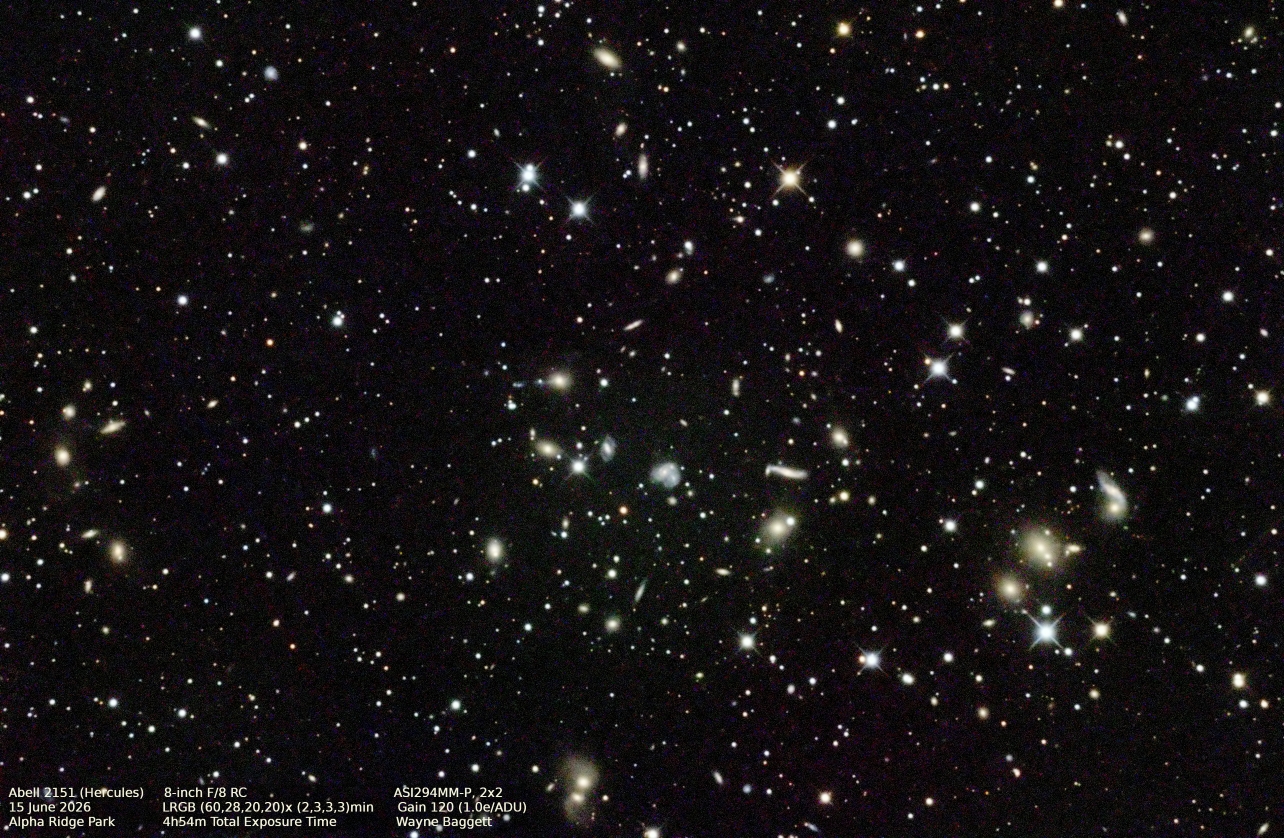
Abell 2151 (Hercules) 15 June 2026 Alpha Ridge Park (c) Wayne Baggett
(c) Wayne Baggett

Members-Only Star Party (Alpha Ridge) 06/14/2026

Despite the uncertain weather forecast, about 12 members showed up last night. 
 
The patchy thin cloud after sunset allowed us to watch Jupitor and Venus (the mercury is behind a wall of horizontal cloud). I could see Arcturus and Vega as well. However, Polaris was only visible through telescopic view. The condition continuously deteriorated till the sky was 90% clouded out by 10 pm.
 
We started to wrap up around 10:30 pm. Wayne kindly offered to lock the gate.
 
Clear skies,
Richard Ren
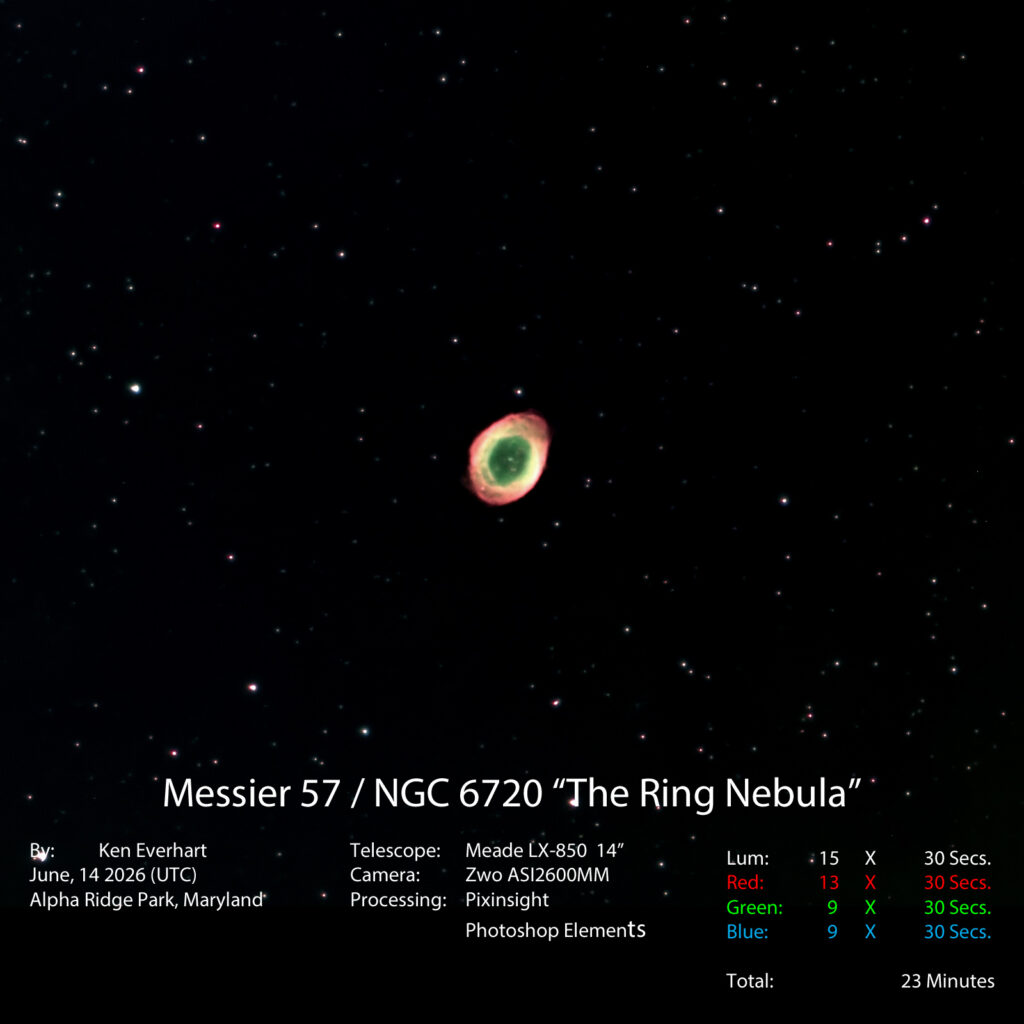
Ring Nebula Ken Everhart

Impromptu Star Party (Alpha Ridge) 5/18/2026

Seven HAL members enjoyed a mix of visual observing and astrophotography on an unseasonably warm night at Alpha Ridge Park.  There was quite a diverse collection of telescopes in use.  Seeing was about average, but transparency seemed poor.  Unfortunately, I started packing up before I thought to take an SQM-L reading and didn’t realize it until after I had already turned the park lights back on.  My personal naked-eye limiting magnitude was worse than 4th magnitude, as I was unable to see Iota Virginis (mag 4.1).  However, that was at an altitude of around 45 degrees in the southern sky, which is heavily light polluted at Alpha Ridge.  Temperature was in the mid 80s to high 70s with very little wind.  Dew didn’t start accumulating until after 11:00.  Mosquitos were present but stealthy.  I didn’t realize that I was incurring bites on the backs of my hands until they started itching, and then I applied some DEET.  Better late than never!

The big news is that Sundar’s Starsense Explorer app is now working!  He reinstalled it and got a new code from Celestron support, and that resolved the issues it was having.  He was thrilled that it’s finally performing well and he enjoyed observing globular clusters M3, M5 and M92 and the fine double star Algieba with his 130mm Newtonian.

Jose continued imaging M101 (Pinwheel Galaxy) with his Carbonstar 150mm reflector and got a lot of good data on it.

Ian was imaging Markarian’s Chain of galaxies in the Virgo Cluster with a Seestar S50.  He also noticed that the transparency wasn’t great, but he was still happy with the results.

Mike was working with a new ZWO 130mm refractor and had a lot of fun imaging M101.  He said that he’s enjoying using this telescope much more than his two previous ones.

Todd started out imaging the galaxy M94 with a Celestron 9.25″ EdgeHD SCT, but switched over to M101.  He showed me stacked images on his tablet at the end of the night and they looked fantastic.  It was a good night for imaging the Pinwheel!

Rich was making visual observations with a TeleVue 60mm refractor and an 8″ Mag One Portaball truss tube Newtonian, which is an interesting and unique scope that I had never seen or heard of before.  He was pleased to have located the globular cluster M13 with just a finder scope and also viewed the moon and double stars Castor and Mizar.

I observed 4 double stars in the northwestern sky (STF 1083, 41 Aurigae, beta Cam and 11,12 Cam) with my Orion Eon 80mm refractor and also the asterism Grohusko-1 in Virgo.  I was trying out a new Svbony dew heater strap on the Orion, and it seemed to work fine (although dew was not much of an issue).  I set up my 8″ Celestron Starsense Explorer Dob later in the evening and viewed M5.  I tried to image M97 (Owl Nebula) with my Vespera and an OIII/SII filter, but it wasn’t able to track the target with the filter in place.  I switched to imaging globulars M53 and NGC 5053, which are only 1 degree apart in the sky and are apparently close together in physical space as well.  I started packing up at midnight with hopes of leaving by 12:30, but I underestimated how long it would take to break down and stow 3 telescopes!  I probably won’t try to use all 3 at once again, but I had something that I wanted to try out on eac

h of them (it was a Starsense Explorer app update for the Dob).  I wonder how many telescopes I could actually fit into my Elantra?  There is really only one way to find out.

After packing up my totally awesome array of telescopes, I locked up HALO, verified all other doors were locked, left the park and locked the gate behind me at 12:50 AM.

Ernie Morse

Impromptu Star Party (Alpha Ridge) 5/09/2026

It was a great night for observing at Alpha Ridge Park on Saturday night.  Skies were clear and transparency was above average (SQM-L reading of 19.25 mpas).  Seeing was about average.  The temperature was down to the mid 50s by midnight with no wind to speak of.  There was some moderate dew accumulation, but it didn’t seem to be much of an issue.

Mike & Dan were both imaging the Pinwheel Galaxy (M101) with 80mm and 122mm Svbony refractors.

Welcome to new HAL member Roger, who was making visual observations with a 125mm Borg refractor.

Joey was working on troubleshooting an imaging setup with an 80mm Explore Scientific refractor.  He got it working and imaged M101 for 30 minutes.

Welcome to Evan, who was also attending his first impromptu.  He observed the Leo Triplet and some globular clusters with an 8″ Dobsonian while also imaging the galaxy M82 with a Seestar.

Brandon and his son were making some visual observations with a 72mm refractor.

There were a few non-members who didn’t know about the impomptu but had intended to stay at the park after dark.  One family just wanted to stargaze without equipment while a couple wanted to set up a telescope for the first time.  I let them know that it was a members-only event and that the park would typically be closed at dusk and gave them information about joining HAL.  The family stayed until just a little after 9:00.  The couple’s telescope turned out to be nonfunctional, so they also left early.  Thanks to Brandon and the other HAL member(s) who gave them some guidance and advice.

It was a frustrating observational night for me.  I had intended to view some brighter galaxies with my 8″ Dob, but only M81 and M82 were really worth the effort, despite the good transparency.  I attempted to find the asterism Grohusko-1 in Virgo mentioned in the June issue of Sky & Telescope, but couldn’t locate it with my 8×50 finder.  I made a finder chart for it with Cartes du Ciel today and I’ll use that next time.  I also found the brightest star in the asterism in the Celestron Starsense Explorer app database, so I could just resort to technology and find it with the app, but I like to go old school from time to time.  I did get a nice image of the asterism with my Vespera II, but that scope then disappointed me by failing to track the Owl Nebula (M97) with a 3rd-party OIII/SII filter.  I salvaged the evening with some nice views of globular cluster M53 and a handful of double stars.

I verified that all park doors were locked, turned on the lights, locked up HALO, locked the gates and departed at 12:15 AM.

Ernie Morse

Impromptu Star Party (Alpha Ridge) 5/04/2026

Two HAL members attended an impromptu star party at Alpha Ridge Park on the night of May 4th.  The sky clouded over intermittently, but the clouds were moving through quickly and the sky was reasonably clear most of the evening.  Temperature was very pleasant (low 60s) and it was only moderately breezy.  Seeing was poor, but transparency seemed at least average.  I didn’t get a sky quality reading, as it was cloudy when I was done observing.

Sundar brought his Celestron 130mm Starsense Explorer Newtonian and we worked together on troubleshooting issues with the push-to app on his phone.  We weren’t very successful, but I remembered that logging can be enabled and the logs can then be sent to Celestron support, so Sundar is going to try that next time.

I made visual observations with my 80mm Orion refractor and 8″ Celestron Starsense Explorer Dobsonian.  I observed the Kemble’s Cascade asterism in the 3-degree field of the Orion and switched to the Dob for the open cluster NGC 1502 (Golden Harp Cluster) that the cascade appears to flow into.  I observed M97, the Owl Nebula, with the Dob and an OIII filter for a good while and almost convinced myself that I could see the eyes from time to time.  A barred owl with a good sense of timing started hooting during those observations.  I tried to see the globular cluster M68 as it was transiting in the southern sky, but I couldn’t make out any trace of it in the sky glow.  I observed double stars Algieba and epsilon Lyrae with the Orion.  I checked in on Jupiter with the Dob around 10:30 and noticed that one of the moons was very close to the planet’s limb.  I made a note to check again later to see if it was moving towards or away from it, but didn’t get back to it until an hour later.  The moon was behind Jupiter by that point.  I checked Sky & Telescope when I got home and found that it was Ganymede and that it moved behind the planet at 11:06 PM.

I finished observing around 11:45 and began packing up the telescopes.  I turned on the park lights around midnight, verified that all doors on the restroom building were locked, locked up HALO and departed at 12:20 AM, locking the park gate behind me.

Ernie Morse

Impromptu Star Party (Alpha Ridge) 4/30/2026

We had a nice night this past Thursday.

There were only 4 members at the star party but the sky was pretty clear and we all took advantage of the bright moon to either troubleshoot things in our telescopes or do some lunar observations.

I closed the park by 11:40 pm.

Jose Urias

Impromptu Star Party (Alpha Ridge) 4/27/2026

Sky conditions were not great for last night’s impromptu star party, with a persistent layer of thin clouds and bright moonlight.  It was a nice night for double star observing and troubleshooting equipment, though.

Ian stopped by to pick up the camera that he won in the HAL auction a few months ago.  He stayed for a while to keep me company while I was setting up and we had a nice conversation about remote astrophotography and general visual observing.

Richard was working on controlling an Orion EQ-26 mount via an ASIAIR controller, with a 4.5-inch Orion Starblast Newtonain reflector as the payload.  Unfortunately,  it didn’t go very well and he left around 10:00.  His previous attempt was partially successful, so hopefully this was just a temporary setback.

I was working with my Orion Eon 80mm ED refractor and was very pleased with the result of the firmware update that I performed on the Sky-Watcher AZ-GTi mount over the weekend.  I did a 3-star alignment with Capella, Procyon and Spica and then pointed to the double star Cor Caroli as my first target.  Go-to performance and tracking were both great.  I hibernated the pointing model and parked the scope in home position when I went out to put the chain around the gate, and it still worked well when I returned.  I was able to split Izar at 112X (10mm EP with 2X Powermate) and was able to achieve a well-focused image at 153X (18.2mm EP with 5X Powermate).  I also observed doubles Castor and Porrima and saw the two stages of the Atlas rocket launched from Florida moving northward between my telescopic observations.

It started to get windy and cloudier around 10:45, so I started packing up.  I locked up HALO and verified that all of the other doors were locked.  I found the door for the utility room with the switches for the parking lot lights and bollards unlocked, so I locked it.  I locked up the park gate and departed at 11:20 PM.

Ernie

Impromptu Star Party (Alpha Ridge) 4/20/2026
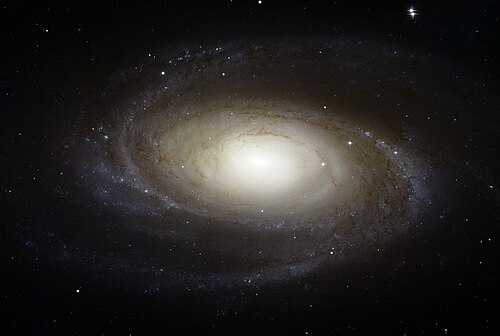
After the iffy conditions during the day, the night turned out to be nearly perfect!  The daytime clouds disappeared by sunset, and the afternoon winds died completely by the time it was dark.  The transparency was much better than average, and the seeing was average or a little better.  The temperature hit freezing at about 1am, so it was as cold as forecast.  My Sky Quality Meter recorded the sky brightness as low as 19.95mag/square arcsec; its been a long time since I saw a value that low, and is probably a reflection of the good transparency. It turned out that I was the only person in the park all night, and I spent my time collecting more photons on M81 (Bode’s Galaxy) for April’s Object of the Month project.  The four hours I gathered tonight brings me to a total of 13 hours in LRGB on M81.  I have attached a preliminary version of the image based on 9 hours collected earlier in the month. I finished my imaging at about 1:40am, then collected flats, refocused my guide camera, and packed up.  I locked the park gate at 3:20am. Wayne Baggett NASA, ESA and the Hubble Heritage Team (STScI/AURA)

Impromptu Star Party (Alpha Ridge) 4/19/2026

Four HAL members attended the impromptu star party of April 19th at Alpha Ridge Park.  The weather forecast was pretty accurate, as skies were clear until midnight and the temperature was 39 degrees by that point.  Transparency was very good (19.29 on the SQM-L, the best reading since 19.40 on August 30th of last year). José was imaging galaxies M81 and M82 in Ursa Major with his Apertura Carbon Star 200 Newtonian. Bianca was imaging the Leo Triplet, also with a Carbon Star 200.  Unfortunately, the mount started making a disturbing amount of noise after a meridian flip, and she stopped imaging in order to begin the troubleshooting process. Shrikant was also imaging the Leo Triplet with his AstroTech 72mm and Canon DSLR camera.  The live-stacked image on his laptop looked really sharp and clear and I was impressed with the visibility of the dark lane in NGC 3628. I observed some very southerly double stars (UZ Pyxidis and zeta1 Antliae), the globular cluster M3 in Canes Venatici and the Ghost of Jupiter planetary nebula (NGC 3242, Caldwell 59) in Hydra with my 8″ Celestron Starsense Explorer Dob while imaging M101, the Pinwheel Galaxy, in Ursa Major with my Vespera II EAA scope. I locked up HALO at midnight, just as clouds were rolling in.  I closed and locked the gate with help from Shrikant, who graciously stayed a few minutes later to assist, at 12:05 AM. Ernie Morse
NASA, ESA and the Hubble Heritage Team (STScI/AURA)

Members-Only Star Party (Alpha Ridge) 04/18/2026

Although sparsely attended, Saturday’s Members Only Star Party saw plenty of action.

A final forecast that predicted partly cloudy weather proved to be inaccurate as skies were cloudy throughout the evening.  I was joined by a new member who wished to see our facilities and another who planned to meet someone to exchange a book.

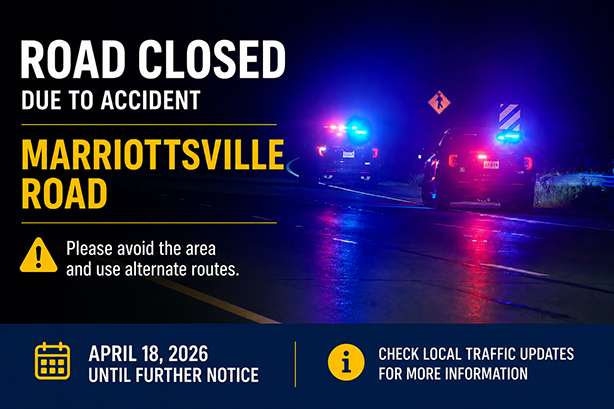
Unfortunately, we found Marriottsville Road closed due to an automobile accident. When I finally arrived at our observing site, I discovered the parking lot filled with several emergency vehicles.  These vehicles were coming and going throughout the evening all culminating with a medivac helicopter landing on the fields just behind the observatory building.
 
Once it was safe to venture back onto the parking lot, the three of us adjourned at 8:45pm.  I left the front gate open as requested by park personnel.

Respectfully Submitted

 
Ken Everhart
 
Accident

Impromptu Star Party (Alpha Ridge) 4/11/2026

Twenty members joined us Saturday evening for an outstanding impromptu star party.  I counted sixteen telescopes around Alpha Ridge with one member actually pointing three scopes skyward.

Although seeing was lackluster, transparency remained above average throughout the night.  In working through my imagery, I was able to tease out a magnitude 18.9 galaxy with a five-inch lens.

Working out kinks in equipment and trying new things seemed to be the theme of the evening with our members learning the isochronies of their equipment, using new equipment and even pointing toward unfamiliar objects. I love it when deep-sky observers discover the planets.

Meanwhile, several others worked on April’s Object of The Month, Messier 81.

Although a few members left earlier, most started packing up around 11:30pm with Phil Whitebloom and I locking the gate at 12:30am.

Thank you everyone for a wonderful night.

Respectfully Submitted,

Ken Everhart

NASA, ESA and the Hubble Heritage Team (STScI/AURA)

Impromptu Star Party (Alpha Ridge) 4/07/2026
Seven HAL members enjoyed a crisp, clear evening of observing and imaging at Alpha Ridge Park last night.  It was chilly and a little breezy at times, but the transparency was better than average (SQM-L reading 19.18 mpas) and seeing also seemed  to be pretty good.

James was working through some issues with his recently-acquired 12″ Newtonian reflector.  He was having some issues with guiding.  He was simultaneously imaging the Orion Nebula with a 120mm refractor.

Jeff was making visual observations with an 8″ Celestron SCT.  He visited Rigel, Betelgeuse, open cluster M67 in Cancer and the Double Cluster in Perseus.

Mike intended to image the Flame Nebula in Orion with an 80mm Orion refractor, but he experienced issues with his control software demanding a firmware update for the mount before it would consent to moving the telescope in small increments for guiding.  He was forced to pack up early, but plans to resolve that issue ASAP.

Mike & Dan were imaging with a pair of Svbony refractors of 122mm and 80mm, respectively.  Mike was imaging M51 in blue, green and luminance, adding to red exposures that he obtained on a prior night.  Dan imaged the Sliced Onion Galaxy in Leo Minor and the Beehive Cluster (M44) in Cancer.

Wayne was imaging spiral galaxy M81 (the Discord group’s object of the month) in Ursa Major with his 8″ RC reflector.

I spent a lot of time setting up for an attempt to sketch the double star eta Persei with my Celestron 8″ Starsense Explorer Dob, followed by about 15 minutes on the actual sketch.  I used a new Orion illuminated reticle eyepiece and an angular measurement card that I made to fit around the focuser barrel to help with estimating the angle of west in the eyepiece and the double’s position angle.  The sketch was a decent effort, but I’m still learning.  I also used the new eyepiece for alignment of the Starsense Explorer app and briefly observed open clusters M35, M37 and M67.  I continued imaging NGC 2264 (Christmas Tree Cluster and Cone Nebula) with my Vespera II EAA scope.

I locked the gate and left around 12:15 while Wayne stayed to continue his imaging.  He finished up at 3:30, locked up HALO and the park gates and departed at 4:40 AM.

Ernie

M1 (c) David Stein
M1 (c) David Stein

Public Star Party (Alpha Ridge) 3/28/2026

I had the pleasure of hosting the first Public Star Party of the year last night, March 28, alongside Ken Everheart and Richard Ren.

The event was a success, with over 200 attendees and 28 member telescopes on-site. I arrived at 6:30 PM to find several members and guests already checking HALO and setting up. We began the observatory session by viewing the moon during the twilight hours. Once it was dark, we observed M81 and M82. At 8:30 PM, we attempted to view the ISS passing through Jupiter’s field of view; while we couldn’t get them in the same frame, the ISS was clearly visible to the naked eye and through binoculars.

We also received a visit from the Park Rangers, who expressed their interest in attending future events. Throughout the evening, I noticed a high level of interest regarding the distances of the objects we were observing. While I didn’t always have immediate answers, this has provided me with a great research focus for my next event as CTO. We concluded the night with views of the Orion and Horsehead nebulae.

I officially closed HALO at 11:00 PM, though a few members remained with Ernie, who took over as the key holder in charge.

This was a wonderful experience and my first time being fully in charge of HALO and guest entertainment. Although I can be nervous speaking to crowds, the guests were very respectful and shared that they had a great time.

Best regards,

Jose Urias

Hal Star Party
Photo by Bob Savoy
Hal Star Party
Photo by Bob Savoy

Impromptu Star Party (Alpha Ridge) 3/19/2026
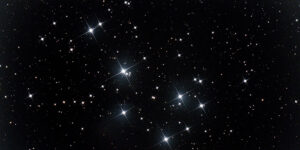
Last night I opened Alpha Ridge for an impromptu star party. I arrived around 7:45 pm and had 5 guests in total. Unfortunately, the sky did not stay as clear as we were hoping. I was still able to image M42 and NGC 869/864 between breaks in the clouds.

We packed things up and locked the gate by 11:30 pm.

I hope to see everyone at the public star party scheduled for March 28th!

-Krystal Rolon

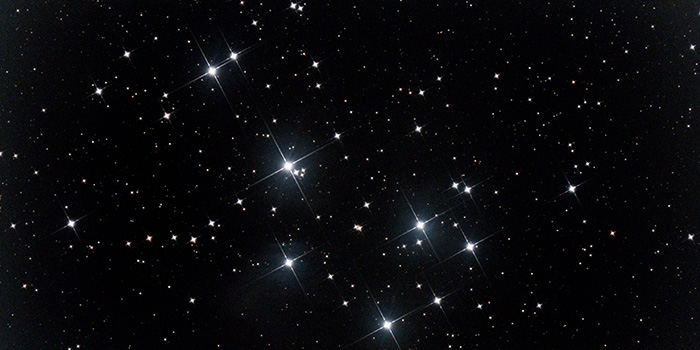
(c) Ernie Morse Pleiades
(c) Ernie Morse M45

Members-Only Star Party (Alpha Ridge) 03/14/2026

The forecast wasn’t very promising for Saturday night’s star party, so I was pleasantly surprised at the turnout of 12 HAL members.  The party got off to a bad start, as it was almost completely overcast around dusk.  Jupiter was frequently visible through gaps in the clouds high overhead, but that was about it.  After waiting it out for over an hour, three people decided to leave around 9:00.  I was about to start packing up myself, when I looked up and noticed that the clouds had cleared out around Orion and Gemini.  The whole sky was clear within a few minutes.  There was still a persistent layer of thin clouds and an occasional denser cloud bank passing through, but the conditions were overall favorable until 11:00.
 
I didn’t gather as much information about the various setups and observations as I usually do, as I expected that we’d be clouded out.  A few people were imaging with refractors in the 80 – 100mm range, including Juan, Hugo and Nathan.  Pat had a refractor and a Seestar S50 and Wes was using a Seestar S30 Pro on an equatorial mount.  Peter was using a refractor and a Sky-Watcher tabletop Dob. Jeff was planning on observing clusters and double stars with an 8″ Celestron SCT.  Jaime and Sundar were making visual observations with a 10″ Dob and a light amplification monocular.  I attempted to sketch the double star Almach, but it didn’t turn out very well.  I also observed galaxies M81 and M82 in Ursa Major and open cluster M35 in Gemini with my 8″ Dob.  Jaime and Wes joined me in observing the two galaxies.
 
I locked up HALO and the park gates and departed at 11:20 PM.
 
Ernie Morse
Ring Nebula Ken Everhart

Impromptu Star Party (Alpha Ridge) 3/10/2026
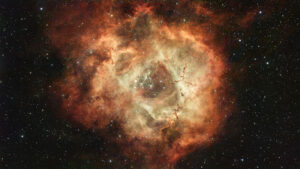
The night was pretty nice with wonderful weather and nice temperatures. We had a few clouds rolling for like 20 minutes at some point but after that it was all clear and nice.

We had a total of 8 members coming, mostly imaging or troubleshooting their gear, but we also had Ernie observing and sketching a double star for the first time!
Bianca spent some time observing Jupiter, Orion and the Pleiades through the 10” dob. Federico used his Seestar S30 in EQ mode of the first time.
Danielle was imaging the Rosette nebula, and I believe the rest of the people were imaging galaxies.

Danielle and I were the last ones at the park and we closed it at 11:45.

Jose Urias

Rosette Nebula - Danielle

Impromptu Star Party (Alpha Ridge) 3/09/2026

We had a really nice impromptu last night!  It was not cold and the sky was entirely clear and nicely transparent.  We had about 20 HAL members show up even though it was the Monday night after the time change. Victor and Jose gave our observatory a check-out run after the winter hiatus and everything is now ready to go for our first public star party of 2026, which will be on Saturday March 28.

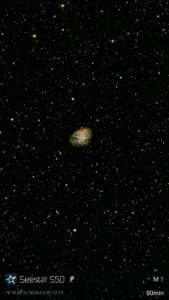
There were five(!) Seestar S50 smart scopes running (as I could see on my wifi menu as I connected to mine).  I took a picture of the Crab Nebula from 8:25 PM to 10:25 PM which netted me 80 minutes of usable data.  Jose was kind enough to volunteer to stay late and lock up so I left about 10:30 PM

David Stein

M1 (c) David Stein
M1 (c) David Stein

Impromptu Star Party (Alpha Ridge) 3/01/2026
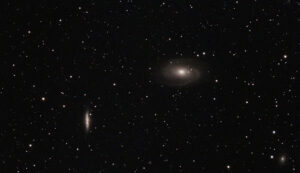
Sunday night’s impromptu was attended by just one HAL member (me).  The moon was very bright, but skies were clear until after 10:00 and there was no wind.  Temperature was down to 33 degrees at 10:30.

I observed 11 double stars across Pisces, Andromeda, Aries, Triangulum, Perseus and Orion with my 8″ Celestron Starsense Explorer Dob:  56 And, 65 Psc, gamma Ari, lambda Ari, 1 Ari, STF 183, iota Tri, 15 Tri, eta Per, iota Ori, lambda Ori.  I hadn’t observed 15 Tri before and was pleasantly surprised by the vivid orange-blue color contrast.  It’s a wide (142 arcsecond) optical double with magnitudes 5.6 and 6.8.  The only one of my double star sources that recommended it was “Observer’s Sky Atlas” 4th edition by Erich Karkoschka, which is an excellent all-around observing guide.  I like that it lists the B-V color indices for double stars to give an idea of which ones will have good color contrast.

My main goal for the night was to test out the new firmware update for my Vespera II EAA scope.  I took short (20 – 60 minutes) exposures of open clusters NGC 752 (Caldwell 28), NGC 2362 (Caldwell 64) and the Pleiades (M45) and galaxies M81 & M82.  I also used a ring with a crossbar (purchased from Etsy) in front of the lens for the cluster exposures in order to get diffraction spikes on the stars because I like the look of spiky stars.

Clouds were moving in from the north by around 10:15 and the sky was also crisscrossed with lingering airplane contrails, so I started packing up.  I locked HALO and the park gates and departed at 10:40.

Ernie Morse

impromptu was attended by just one HAL member (me).  The moon was very bright, but skies were clear until after 10:00 and there was no wind.  Temperature was down to 33 degrees at 10:30. I observed 11 double stars across Pisces, Andromeda, Aries, Triangulum, Perseus and Orion with my 8" Celestron Starsense Explorer Dob:  56 And, 65 Psc, gamma Ari, lambda Ari, 1 Ari, STF 183, iota Tri, 15 Tri, eta Per, iota Ori, lambda Ori.  I hadn't observed 15 Tri before and was pleasantly surprised by the vivid orange-blue color contrast.  It's a wide (142 arcsecond) optical double with magnitudes 5.6 and 6.8.  The only one of my double star sources that recommended it was "Observer's Sky Atlas" 4th edition by Erich Karkoschka, which is an excellent all-around observing guide.  I like that it lists the B-V color indices for double stars to give an idea of which ones will have good color contrast. My main goal for the night was to test out the new firmware update for my Vespera II EAA scope.  I took short (20 - 60 minutes) exposures of open clusters NGC 752 (Caldwell 28), NGC 2362 (Caldwell 64) and the Pleiades (M45) and galaxies M81 & M82.  I also used a ring with a crossbar (purchased from Etsy) in front of the lens for the cluster exposures in order to get diffraction spikes on the stars because I like the look of spiky stars. Clouds were moving in from the north by around 10:15 and the sky was also crisscrossed with lingering airplane contrails, so I started packing up.  I locked HALO and the park gates and departed at 10:40. (c) Ernie Morse
(c) Ernie Morse
(c) Ernie Morse Pleiades

Impromptu Star Party (Alpha Ridge) 2/20/2026
Friday’s impromptu star party was announced on a cloudy afternoon following a rainy morning, but the forecast for clear evening skies was accurate.  Seven HAL members attended on a night that presented some challenges from fog and wind.  Conditions were much better once the 3-day-old moon set just after 9:30, with the fog having cleared out and the winds abating.  Transparency and seeing were both about average, with a sky quality reading of 19.16 mag/as^2 at 10:30 PM.  It was about 50 degrees at sunset and in the low 40s at the end of the night.

Evelyn was trying out the mono camera, filters and filter wheel that she won in the HAL auction.  I assume she was using them with her Sky-Watcher 80mm refractor, but I forgot to ask.  She was imaging the Orion Nebula with a sequence of filters and everything was working well.

Jose intended to image the Thor’s Helmet Nebula in Canis Major, but the fog made it impossible, so he switched to the Orion Nebula.

Shrikant imaged the Horsehead Nebula with his 72mm AstroTech refractor and Canon D77 camera.

Brandon and his son Jamison were making some visual observations with a new Svbony 80mm refractor.  Jamison was happy to have identified the moons of Jupiter and to have discovered a little triangular asterism.

Mike attempted to image the galaxy M81 in Ursa Major with his Svbony 122mm refractor, but that attempt was negated by the fog.  He switched over to the Horsehead Nebula, but the high winds ruined his guiding.

Two park rangers, Deana and Esteban, stopped by to check on how we were doing.  I showed them the Orion Nebula, Jupiter and the moon and Jose chatted with them about his imaging.

I observed some Messier open clusters with my 8″ Dob (M38, M41, M46 and M47) and used an OII filter to get a better look at the planetary nebula in the foreground of M46.  After the fog lifted, I set up my Vespera II EAA scope and imaged the Pleiades for an hour.

I locked up HALO and the park and departed at 11:15 PM.

Ernie

Pacman Nebula (c) Ernie Morese
Pacman Nebula (c) Ernie Morse

Impromptu Star Party (Alpha Ridge) 2/13/2026

There was a good turnout of 14 HAL members for the impromptu star party at Alpha Ridge Park on February 13th.  Skies were clear except for a wide band of clouds that moved through around 8:00 PM.  The temperature started in the low 30s, decreasing to around 25 at 11:00 PM, and winds were calm.  Transparency seemed bad through the eyepiece and my SQM registered only 18.75 at 10:45.  Seeing was about average.  Although some misfortunes were encountered on this Friday the 13th event, it was overall an enjoyable night of observing.

Ashley and Jason were conducting visual observations with a Celestron Starsense Explorer Newtonian.  I didn’t get the specs, but I’d guess that it was a 130 mm.  They observed stars and clusters, including M44 (the Beehive).

New members Patricia, Jesse and Jay didn’t have any equipment to use, but they were able to share some views through Ashley and Jason’s telescope and my Dob.  I showed them M42 (Orion Nebula).

Jamie observed several objects with a white phosphor light amplification monocular, including the Andromeda Galaxy, Flaming Star Nebula and California Nebula.

Jose had planned on imaging the Thor’s Helmet Nebula, but didn’t get good results and switched to the Orion Nebula.  I think he was using his 150mm CarbonStar RC.

Ian was imaging the Jellyfish Nebula with his Seestar S50.

Shrikant imaged the Rosette Nebula with his AstroTech 72mm refractor and DSLR camera.

Mike P. was planning to image the Christmas Tree Cluster and Cone Nebula with his Celestron EdgeHD 8″ SCT, but wasn’t able to get good results.

Todd was working out the kinks with a new Celestron EdgeHD 9.25″ SCT.  He initially experienced star images that looked like donuts, but that cleared up after a while.  He was thinking that maybe the scope just needed more time to cool down.  I forgot to ask about his imaging target.

Mike D. and new member Dan were imaging with Mike’s usual 122mm Svbony refractor and a secondary scope, which appeared to be a smaller refractor.  I also didn’t get a chance to ask what they were imaging before they left.

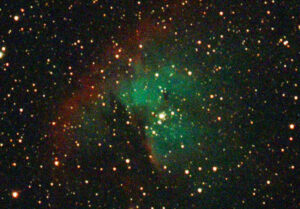
I had planned on observing open clusters in Cassiopeia with my 8″ Celestron Starsense Explorer Dob, but found them visually unimpressive under the conditions.  I eventually abandoned the plan and just viewed some of my favorite objects, including the Double Cluster, M41 and the Tau Canis Majoris Cluster (Caldwell 64).  I also enjoyed some multiple stars:  iota Cas, beta Mon (both close triples) and HJ 3945 (winter Albireo).  I was able to split gamma Ceti with 170X after a couple of unsuccessful attempts last year.  Its separation is currently 1.8 arcseconds and it’ll be decreasing for the rest of my lifetime (down to less than an arcsecond twenty years from now), so I was glad to be able to split it now.  I tried out a new Optolong L-Synergy SII/OIII filter with my Vespera EAA scope.  I imaged the Pac-Man Nebula (NGC 281), which I had read was a significant source of SII (ionized sulfur) emissions, but it didn’t seem like much in the JPG produced by the telescope after 87 minutes of exposure time(attached image, red is SII and blue-green is doubly-ionized oxygen (OIII)).  Unfortunately, I fumbled the filter trying to insert it into the filter cell in my dew shield and got fingerprints all over it as I managed to catch it before it hit the ground.  I also tried out a new heated vest, and it helped to keep me comfortably warm all night.  The 15 oz. of coffee that I brought in my insulated Yeti mug also helped in that regard.

Shrikant and I were the last ones left at the end of the night.  I locked up HALO and the two of us locked the park gates and left at 11:25 PM.

Ernie

Pacman Nebula (c) Ernie Morese
Pacman Nebula (c) Ernie Morse

Impromptu Star Party (Alpha Ridge) 1/20/2026
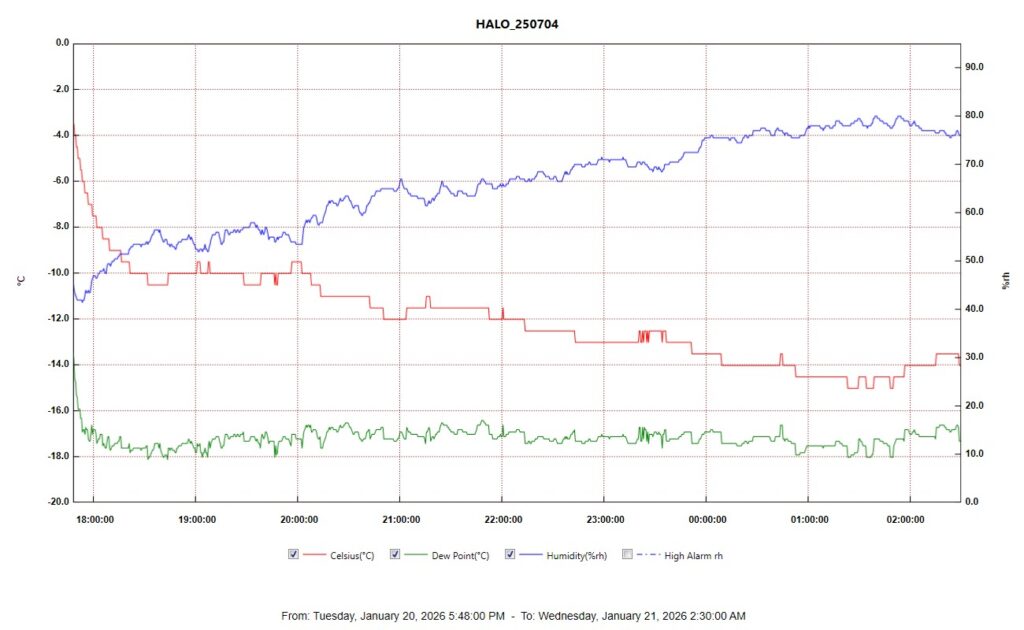
 

In what was possibly the coldest star party ever run by HAL — the
temperature started the night at about 23 degrees Fahrenheit (-5C) and
ended at about 5 degrees (-15C); see the attached plot of temperature
(red line) from a data logging device I use — seven intrepid HAL
members came to Alpha Ridge Park for last night’s impromptu star party.
There were some clouds early on, after a beautifully clear day.  I
suspect that the clouds were mostly airplane contrails blown in by the
jet stream, but I cannot be certain of that.  They cleared out by about
8:30pm, though, and the rest of the night was clear.  Transparency was
about average after the clouds left, and the seeing was not very good.

Everyone was imaging tonight; there were no visual observers except a
family of apparently former HAL members who dropped by for a few minutes
to see the nonexistent auroras.  They unsuccessfully tried to capture
the auroras with a cell phone and were thus imaging, too.  Bill used his
ZWO Seestar S50 to image the Orion Nebula (M42) and the Pleiades (M45),
but the clouds thwarted his efforts to a large degree.  Ruth and her
husband, Eric, used a ZWO Seestar S30 to image the Pleiades, also.  Todd
imaged the Orion Nebula with his William Optics 91mm refractor, and Jose
imaged Bode’s Galaxy (M81) and the Cigar Galaxy (M82) with an Apertura
8-inch Carbonstar RC telescope.  I spent the entire night imaging the
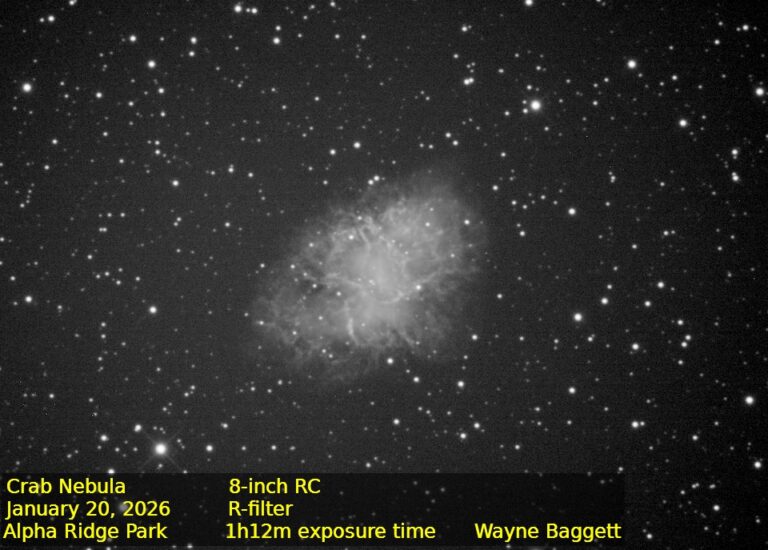
Crab Nebula (M1) with my 8-inch RC scope; I have attached the Pixinsight
Livestack image of the R-filter after cropping and applying a separate
stretch to the data.  Gary left as I was talking to everyone and I
didn’t find out what he was doing, but it was good to see him.

I finished my imaging at about 2:00am, then collected by flats and
packed up.  I locked the park gate at 3:35am.

It was nice to see all the members who came out for the night; hopefully
we can get together again soon, hopefully under warmer conditions.

Wayne B.

Scopes and Chill
Crab Nebula (c) Wayne Baggett

Impromptu Star Party (Alpha Ridge) 1/07/2026

First of the Year

Six HAL members attended the first impromptu star party of 2026 on the balmy (for January) evening of January 7th.  The temperature was in the low 50s at sunset and down to 40 by 9:30 PM.  Winds were calm and the sky was clear except for a large band of clouds that moved through quickly around 8:00.  Seeing and transparency were both about average.  Zenith sky quality measurement with my Unihedron SQM-L was 19.18 mag/as^2 at 9:30.

Welcome to Sam, who attended his first impromptu star party!  He was trying out a new Apertura 8″ Dob reflector with a custom-built tracking platform and an electronic focuser.  He got in some visual observations of Saturn and Jupiter.

Evelyn was also trying out new equipment, a Skywatcher Esprit 80mm refractor and mount.  She was taking some test images of the Pleiades, and the setup was working really well.

Todd was using a Williams Optics refractor to image the Orion Nebula.  He initially had some problems with auto focusing, but he was able to diagnose and correct the issue and ended up getting impressive results.

Paul was struggling with a stubborn Celestron 6″ catadioptric and I don’t know if he was ever able to get it working.  He didn’t leave early, so I hope he was able to overcome the issues and get in some observing.

Bill was running not one, but two EAA scopes!  He had a Seestar imaging the Crab Nebula (M1) and a Celestron Origin imaging the Flaming Star Nebula (IC 405, Caldwell 31) in Auriga.

I did visual observing with my 8″ Celestron Starsense Explorer Dob.  I started with the double star 3 Pegasi, which makes a nice double-double with STT 443 in the field (7′ north preceding) and I also observed the showpiece double Acamar in Eridanus when it transited at 8:00 at an altitude of just 10 degrees.  The Starsense Explorer app was able to find it in the extreme southern sky glow, although the 3rd and 4th magnitude white stars (separated by 8.6″) looked about 2 magnitudes fainter and it was difficult to keep them in focus.  I also observed Jupiter as the great red spot transited the meridian and the outstanding open cluster M37 in Auriga, which Stephen O’Meara describes as “a 9th-magnitude topaz jewel surrounded by a pear-shaped cluster of scintillating diamonds.”  I also continued a mosaic of the Flaming Star Nebula and the Tadpole Nebula (IC 410) with my Vaonis Vespera II EAA telescope, capturing 577 ten-second exposures before having to stop at 8:30 when Auriga got too high in the sky.

My only new equipment was a red 20-oz. Yeti insulated travel mug that my parents got me for Christmas.  I filled it with 12 oz. of hot chocolate from Starbucks on the way to Alpha Ridge, and it did a fine job of keeping it hot as I sipped it between observations.  However, it wasn’t a great test night, as it was so balmy.  Looking forward to trying it when it’s down in the 20s!

I locked up HALO and the park gates just after 10:00 PM and had a very pretty view of the rising moon as I drove east on I-70.

Appendix A:  my recent sky quality measurements:
11/13 Sky Meadows State Park in Virginia:  20.41
11/23 Alpha Ridge:  19.20
12/12  Alpha Ridge:  19.06
12/23 parents’ backyard in Michigan:  20.26 (bad night, I usually get around 20.7 here)
1/7  Alpha Ridge: 19.18

Ernie

Impromptu Star Party (Alpha Ridge) 12/20/2025

A Singular Event

I was the only attendee for an impromptu star party at Alpha Ridge on December 20.  Temperatures were in the mid 30s, winds were calm and the sky was mostly clear, although some clouds moved through in the 7:00 hour.

I set up my Vespera EAA scope to image the Flaming Star and Tadpole Nebulae in Auriga and made some visual observations with my 8″ Celestron Starsense Explorer Dob.  I found a little dipper-shaped asterism of stars in Pisces via a few short star hops from the 4th-magnitude star Iota Piscium in the circlet of Pisces.  This object is number 107 in Stephen O’Meara’s book “Hidden Treasures.”  I then started observing the targets within 10 degrees of Polaris described in the “Suburban Stargazer” column from the November issue of Sky & Telescope.

Unfortunately, my observations were interrupted by an incident just before 8:00.  I was about to put in an O III filter to observe planetary nebula IC 3568 (Hidden Treasure 64), when I saw light spill out from one of the bathroom doors.   This was shocking because I had checked the park for cars and made sure that nobody was in the bathrooms before I locked the gates at 5:35.  I hadn’t propped open the restroom doors because I didn’t intend to stay as late as their automatic locking time, so I knew that they had been closed.  I watched the area for several seconds, wondering if I had really seen the light or just somehow imagined it, but then the light flashed again and I thought I heard one of the doors open.  I quickly grabbed my phone from the Starsense dock, jumped in my car and pulled out into the road in front of the bathrooms.  I stayed there for a minute or two and didn’t see anyone around, but I saw that the motion-triggered light was on in the men’s room.  I called a ranger, who told me that I could just lock up and leave and that one of the rangers might come around later in the night to check on things.  I turned on the park lights and locked up HALO and then packed up my gear while keeping an eye on the restroom area.  I saw a fox running down the road, but no humans.  I had the deadbolt locked on the HALO door while I was observing, so nobody could’ve gotten in there during that time.

I locked up the park gates and left at 8:35 without any further incidents.

Ernie

Impromptu Star Party (Alpha Ridge) 12/12/2025

Three HAL members turned out on a chilly winter night for an impromptu star party at Alpha Ridge Park last night.  The temperature was 26 degrees when I took my sky quality meter readings at 8:35 PM, but there wasn’t any wind to speak of, so it was pretty tolerable.  Skies were clear for the whole evening, with transparency and seeing both seeming a little below average.

Welcome to Evelyn, who attended her first HAL impromptu!  She had intended to image M33 (Triangulum Galaxy) with a Canon DSLR and a 200 mm f/4 lens on a 3D-printed mount, but it was uncomfortably close to the zenith by the time she was ready to start, so she switched over to the North America Nebula (NGC 7000, Caldwell 20) in Cygnus instead.

Mike attended to test out his new mono camera.  He took test images of the Pleiades with the camera and his 122mm Svbony refractor.

I observed objects in Cepheus with my 8″ Celestron Starsense Explorer Dob, including double stars (beta, delta, kappa, xi and omicron Cephei), open clusters (NGCs 6939, 7160, 7380, 7510 and M52) and a challenging planetary nebula, the Bow-Tie Nebula (NGC 40, Caldwell 2).  I imaged the Fireworks Galaxy (NGC 6946) and the cluster NGC 6939 with my Vespera II EAA scope.  The Fireworks Galaxy is so named because it’s had 10 supernovae in the past century (most recently in 2017), which is roughly 10 times the rate in our galaxy.  No supernova last night, though, so no fireworks for me.

I locked up HALO and the park gates and departed at 9:15 PM.

Ernie

Impromptu Star Party (Alpha Ridge) 11/23/2025 – 11/24/2025

One night leads to the next day.

The night was nice and a little cold but the moon set early and 5 members attended the party. 4 of us were imaging and Earnie was doing some visual astronomy and also imaging with his Vespera.

For what I could see, one person was doing the helix nebula, another one the flaming star nebula, and I was doing the Pleiades.

I closed the park at around 11:45 pm as it got really cold and we did not prepare for it.

No incidents to report, however, I tested the red bollards as someone asked me last time and they all look fantastic with the new filters.

I also noticed the gate to the park is vent like of it was hit by a car or a truck. It made it quite difficult to close.


Jose Urias

Part 2

Just to report the second half of this impromptu star party. The first half of the party was hosted by Jose on November 23.

I arrived at Alpha Ridge Park at 3:35 am yesterday and unlocked the gate (the gate was very well locked so good job Jose!). I closed the gate with the bungee rubber band and left it unlocked.

I was the only member who showed up.

The weather was calm and the sky was clear. The temperature was in the mid 30’s.
I was able to capture some images for I3/ATLAS, though the guiding was barely tolerable. I haven’t got time to process the photos yet.

By the time I left Alpha Ridge around 6:15 am, apparently someone had widely opened the gate and parked a school bus at the entrance (inside the park). I left the gate as was.

The take home message is that I feel the eastern horizon of Alpha Ridge Park at the playground is as clear as the Carrs Mill park (though it is not available any more). For the clearest western horizon, no place is better than the Howard County Conservancy.

Richard Ren

Public Star Party (Alpha Ridge) 11/01/2025

It was a great turn out for members and the public. David and I lost count at around 200 people. There were a lot of groups and families who joined us for view from over 15 telescopes setup and 2 exhibit tables. The lines were long but the excitement was big to see the rings of Saturn edge on and the various features of the moon which were the main show along with star clusters and double stars because of the thin cloud cover that ruled the evening. The observatory finished off the evening with a small group and continued views invaded by clouds.
Thank you to everyone who shared views from their telescopes and helped HAL finish off another great year!

Hosts:

Christopher Miskiewicz

and 

David Stein

Hal Star Party
Photo by Bob Savoy
Hal Star Party
Photo by Bob Savoy

Impromptu Star Party (Alpha Ridge) 10/27/2025

Four HAL members took a gamble that Alpha Ridge Park would stay just out of the range of the massive cloud band to the south, but that bet didn’t pay off.  There were thin, high clouds covering most of the sky right from the start, and they gradually got thicker, especially in the southern sky.  It was a bit colder than I expected as well, getting down to 42 degrees by 9:30.

Shrikant attempted to continue his imaging of comet Lemmon with his Astro-Tech 72 mm refractor, but he was pretty much foiled by the cloud cover.  Mike and Brian also attempted comet imaging with a 122mm Svbony refractor, with similar results.  They moved on to imaging the Iris nebula in Cepheus, as the northern skies were somewhat less hopeless than the southern.

I managed to get in some limited visual observing with my 8″ Celestron Starsense Explorer Dob.  I started with a quick look at comet Lemmon and then moved on to 7 double stars in the region from eastern Ophiuchus to western Capricornus, highlighted by 70 Ophiuchi and 59 Serpentis.  Double star expert Sissy Haas describes both stars in 70 Oph as being bright tangerine orange, and the 59 Ser pair as lucid yellow and royal blue.  I wish I could see that much color in doubles! I did get at least a hint of those colors, especially in the 70 Oph secondary, which seemed very orange.  I then moved on to open cluster M52 and the striking red-blue optical double STTA 254 (aka WZ Cas) in Cassiopeia.  I finished up with the Double Cluster in Perseus, and the very large open cluster Stock 2 (the Muscleman Cluster).  The latter is not in the Starsense Explorer app’s database, but it was easy to locate it starting from the Double Cluster, following the directions in Stephen O’Meara’s book “The Secret Deep.”

I conceded defeat to the clouds and the cold at 9:30, about a half hour after the other attendees had left.  Well, maybe not defeat exactly, as I did see some good stuff.  I’d say I fought the clouds and cold to a draw.  I locked up HALO and the park gate and departed a little after 10:00.

Ernie Morse

Members-Only Mentorship Night (Alpha Ridge) 10/25/2025

We had a very successful Members Mentorship Night last night. About 20 members came out, some seeking help and some offering it. Although it was entirely clouded over, progress was still made with some creative work-arounds such as looking at lights in the distance to check out equipment. After a very satisfying night of fellowship and discussion, everyone finished up and left and I locked the park about 9:00 PM.

Thank you very much to all the mentors who came out to help out their fellow HAL members!

Clear skies,
David Stein

Impromptu Star Party (Alpha Ridge) 10/24/2025

The weather was very cooperative last night. The sky at western horizon turned clear just about 7:15 pm. However, the altitude of Lemmon comet (Comet C/2025 A6) was low. Phil and I scrambled to take some photos before it fell below the tree line around 8:15. It is amazing that almost none of my two dozen photos does not have a satellite trail.

Later Michael joined us for some deep sky imagings.

We wrapped up around 11 pm and locked gate around 11:20.

Good luck to the HAL mentorship night today!

Richard Ren

Comet C/2025 A6 (Lemmon)
Antonio Ferretti, CC BY-SA 4.0 , via Wikimedia Commons