

October 2025 Objects of The Month, “Teddy Bear Nebula and Question Mark Nebula”

This image of the “SH2-171 Teddy Bear Nebula
AT115EDT scope @ 805mm, ASI294MM, Astronomik filters. 75×300″ HA, 100×300″ OIII, 74×300″ SII, 10×180″ each RGB for stars. Total 22hrs. Taken across Sept 7, 8, and 18 from Severn (Bortle 7). Processed in PixInsight and combined with the “Foraxx” pallette and RGB stars. -Dave Hickey
and Question Mark Nebula -Jared Case
September 2025 Object of The Month, “Veil Nebula”
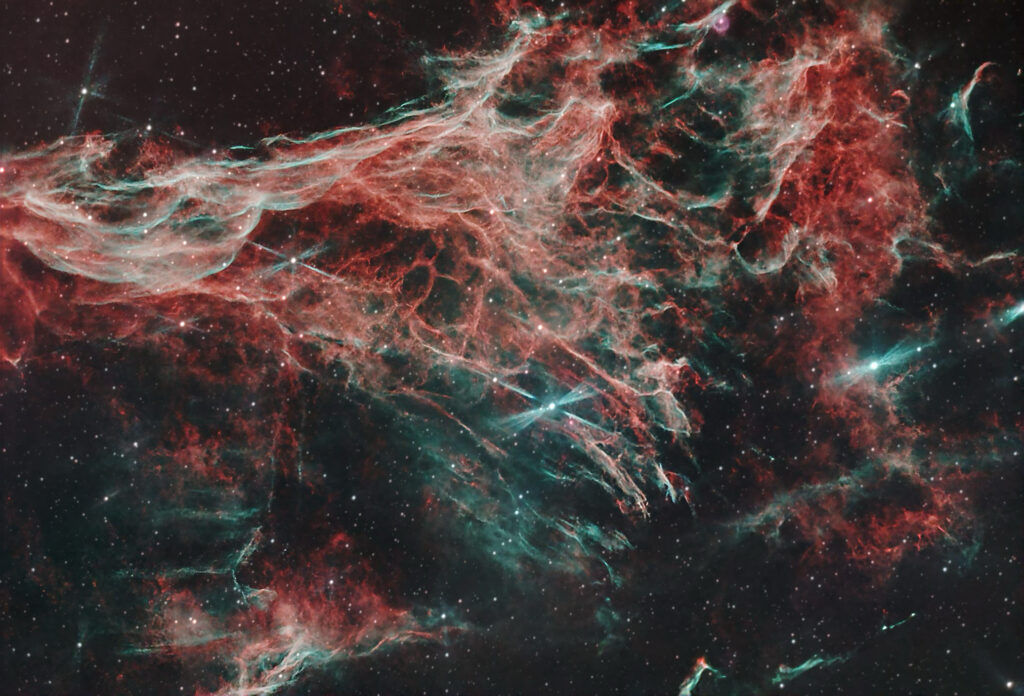
This image of the “Pickering’s Triangle” region of the Veil Nebula was captured this month under Bortle 5 skies in Linganore, MD using a 9.25″ Celestron SCT at f6.3. Additional capture details…
Losmandy G11G
ASI294mc pro
ZWO duo narrow band filter
107 x 180” lights with darks, flats and dark-flat calibration frames
NINA, PHD2, and PixInsight
August 2025 Object of The Month, “Cygnus Wall region of NGC 7000”
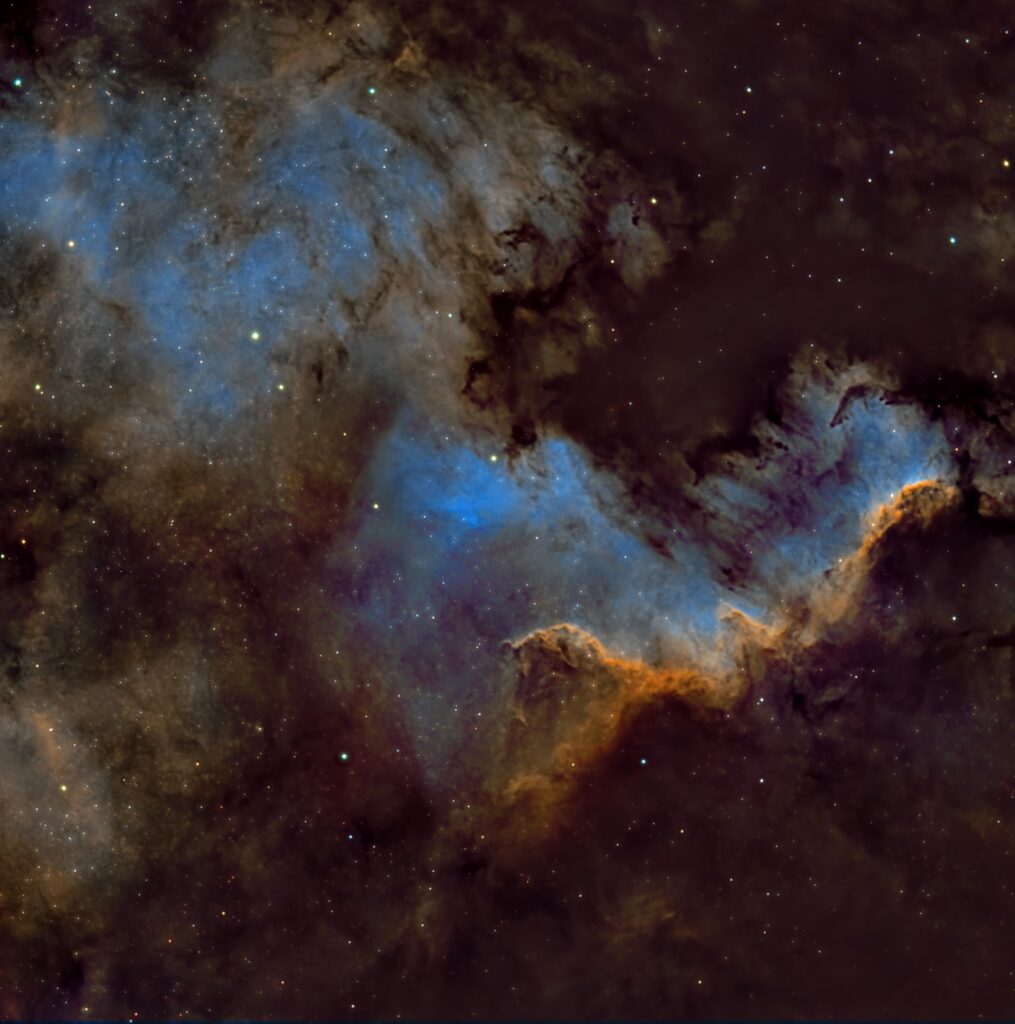
This image was captured over two partly-cloudy nights in August, 2025 and submitted as an Object of the Month entry to the HAL Discord Group. Capture Details:
5h 23m
SII – 36m (6x360s)
Ha – 2h 4m (31x240s)
OIII – 1h 16m (12x360s,1x240s)
UV/IR – 47m (47x60s)
Camera – ASI533 MC Pro
Scope – William Optics Z61 with flattener for f5.9 @ 360mm
Mount – EQM35
Guiding – Askar OAG with ToupTek IMX290 mono planetary camera
Filters – Svbony 5nm S,H,O, & UV/IR
Acquisition – N.I.N.A.
Stacking and Processing – Pixinsight, GraXpert
July 2025 Image of The Month, “The Flying Bat & Squid Nebulae”
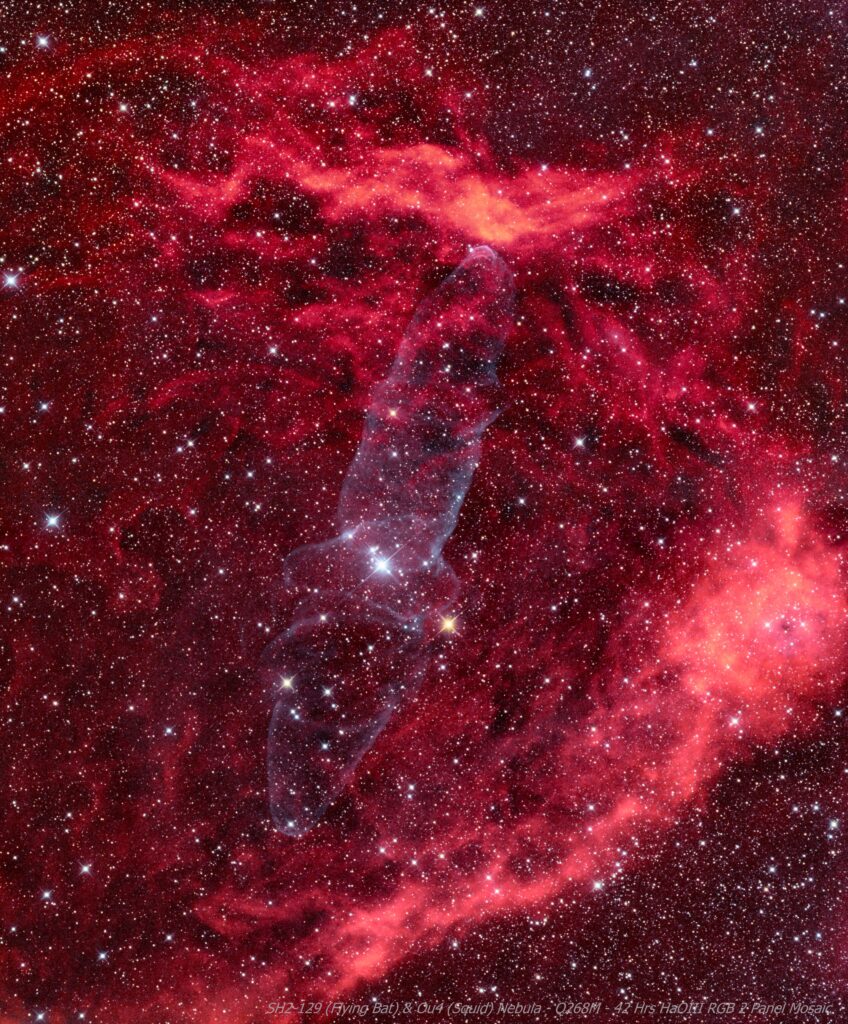
This is a two-panel mosaic of 42 hours of exposures taken with an 8″ f/4 reflector and a QHY268M camera using Ha and OIII filters and RGB filters for the stars. The Flying Bat nebula (Sh2-129), discovered in the 1950’s, shows up in hydrogen alpha light and is here colored red and yellow. The Squid nebula (Ou4) was discovered by an amateur astronomer in 2011 and emits primarily oxygen III light, here colored blue green. The Squid nebula is extremely dim and one of the faintest nebula I’ve imaged. While the distance to these objects is not at all certain, they are believed to be physically related with the Flying Bat being an HII region and the Squid believed to be the outflow from the bright star system at its center.
June 2025 Image of The Month, “Sirius A & B”
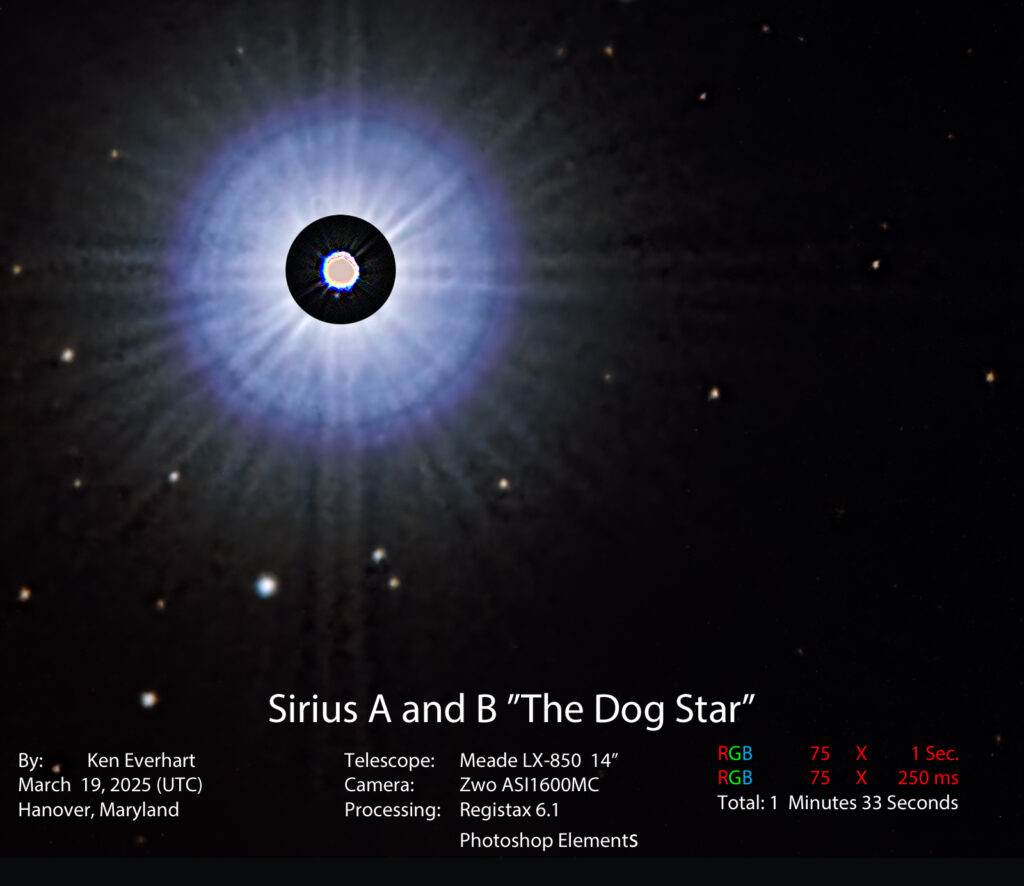
Sirius, the brightest star in the night sky, is orbited by a much fainter companion, “Sirius B.” Orbiting its primary every 50-years, Sirius B is the closest example of a “White Dwarf Star.”
Sirius B can be seen in this image as a tiny white dot just below its brighter companion. While Sirius shines at magnitude -1.67, Sirius B appears as magnitude 8.4 – fainter than Neptune! Moreover, they are currently separated by a tiny 10 arc seconds! To capture both stars. I imaged Sirius with a series of short 250-millisecond exposures. After stacking them, I processed the stack in the same way I tease Jupiter’s innermost moons out of the data.
May 2025 Image of The Month, “M3”

Captured from Pie Town, New Mexico using 14″ PlaneWave CDK14 reflector and QHY600 Camera.
41 hours total integration time:
419 x 120s on Sloan g’
412 x 120s on Sloan r’
416 x 120s on Sloan i’
April 2025 Image of The Month, “Our Sun, March 25th, 2025”
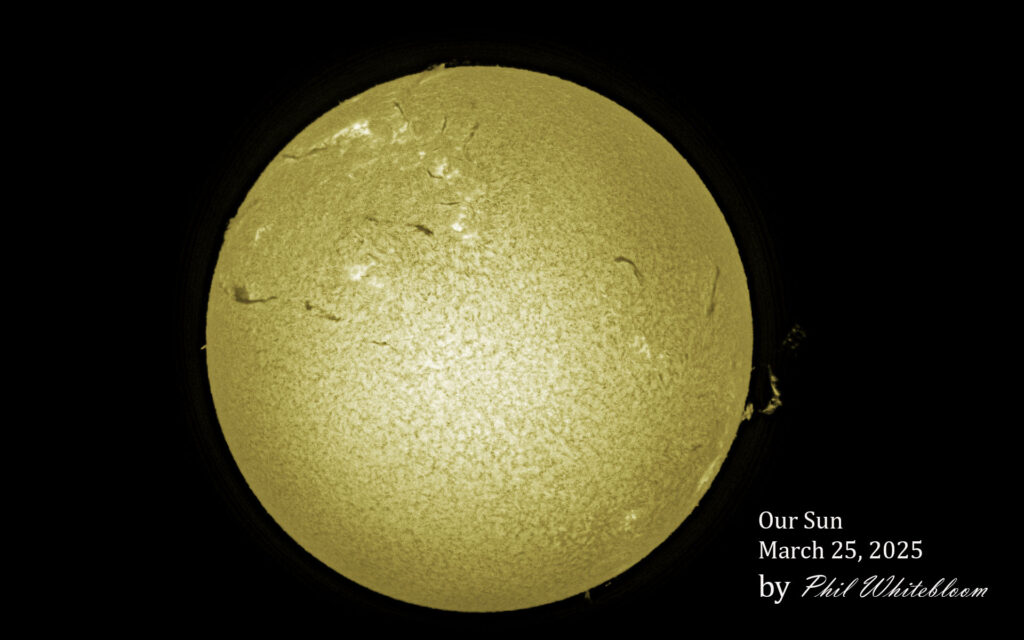
From Phil:
I was able to capture this picture through a thin cloud layer. They just did not want to entirely clear for me. Very nice prominence off the right edge of the solar disk. Thanks to my friend Steve J. for making me aware of it.
This was captured as a monochrome (B&W) image and for artistic impact, artificially colored using Adobe Lightroom Classic; viewers love the yellow Sun. 🙂 This picture was capture using a 60mm Lunt Hα telescope in the double stack configuration.
Camera: ZWO ASI294MC Pro
Capture software: SharpCap
March 2025 Image of The Month, “Blood Moon” Total Lunar Eclipse
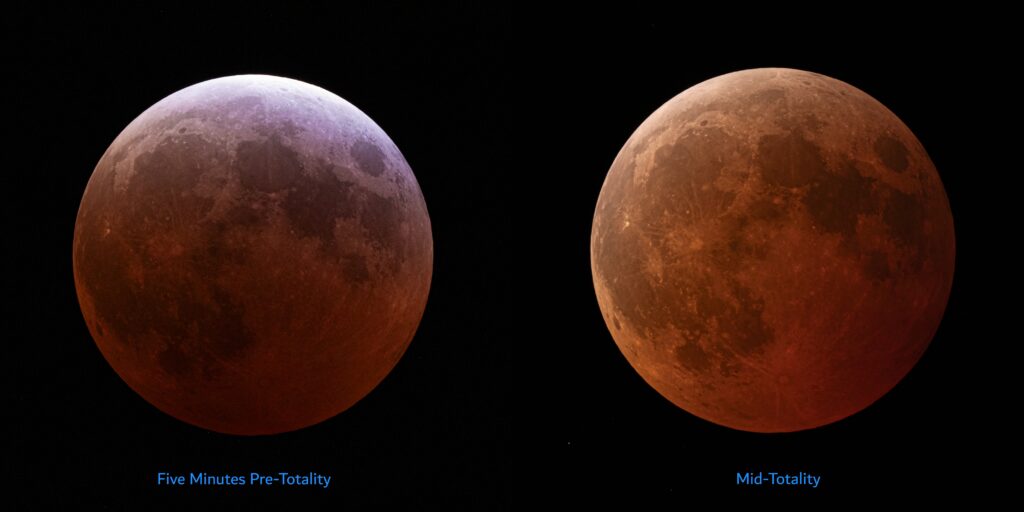
Total Lunar Eclipse taken from Elkins, WV on March 14th, 2025 Taken by James Willinghan.
The left image shows the “Japanese Lantern Effect” which is noticeable up to 5 minutes before and after the total eclipse.
Images taken with Canon T7i camera through Williams Optics 132mm refractor telescope.
February, 2025 Image of The Month, SH 2-308, The Dolphin Head Nebula
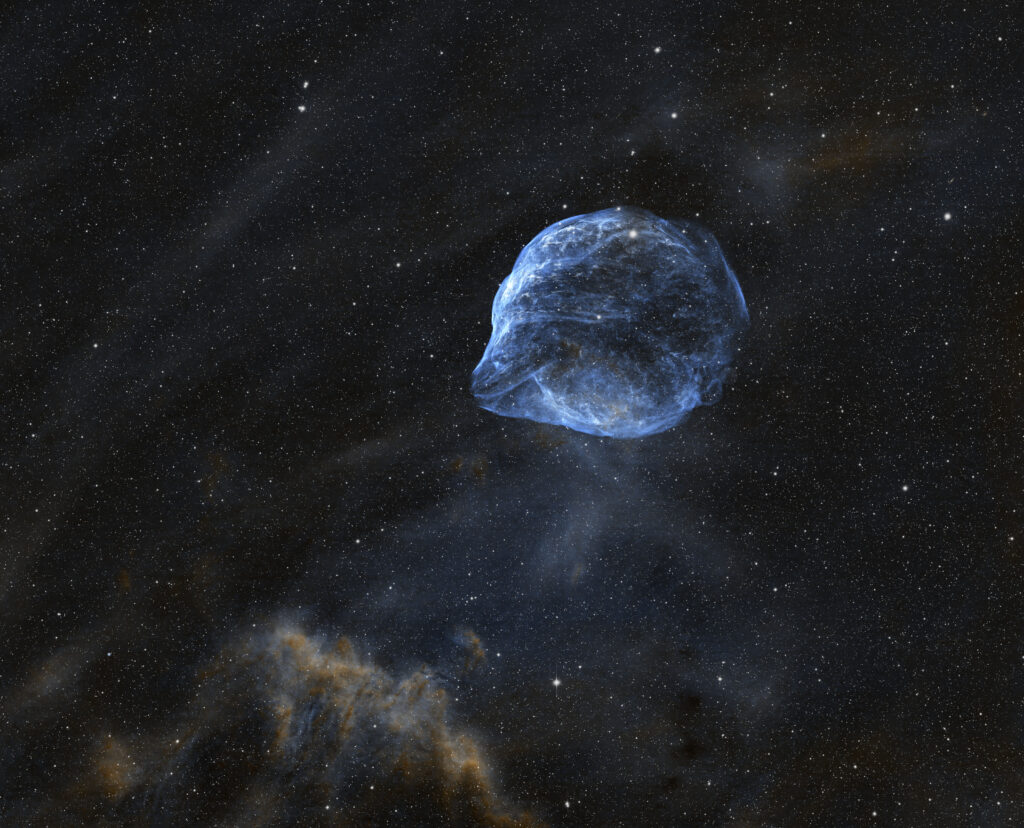
object: The Dolphin Nebula (SH 2-308)
imaged by: Jim Johnson
image capture/processing details:
HOO Palette
Tele Vue NP101is/ZWO ASI6200MM-P
Scout Key, FL (Winter Star Party 2025), Bortle 3
Ha 20 x 600s = 3:20
OIII 26 x 600s = 4:20
Total integration: 7:40
May 2024 OOTM was M51, the Whirlpool Galaxy.

object: Whirlpool Galaxy (M51)
imaged by: Jared Case
image capture/processing details: Captured with a 130mm Refractor, at 737mm focal length. The camera was a monochrome 2600MC.
Red : 1hr 15min @ 180s
Blue : 1hr 15min @ 180s
Green: 1hr 15min @ 180s
HA : 2hrs 4min @ 240s
Lum: 4hrs 40min @ 180s
location: Highland, MD
date: May 2024