

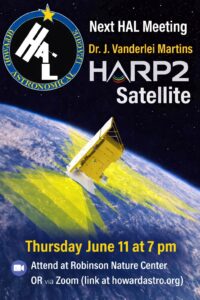
Presenter: Dr. Vanderlei Martins, Director, UMBC Earth and Space Institute
Artifacts: YouTube Video Meeting PDF
The meeting took place on June 11, 2026 at 7 PM on Zoom and at the Robinson Nature Center.
Speaker:Dr. Vanderlei Martins, UMBC Earth and Space Institute
Speaker Bio:
Dr. Martins is the founder and current Director of the Earth and Space Institute at UMBC and a leading expert in aerosol and cloud remote sensing. He spent over a decade working at the Climate and Radiation Branch of the NASA Goddard Space Flight Center as part of the UMBC-GSFC Joint Center for Earth Systems and Technology (JCET), and has held faculty positions at the Department of Atmospheric Sciences of the University of Washington, and at the Department of Applied Physics of the University of Sao Paulo. For over two decades, Dr. Martins has worked closely with NASA engineers and scientists to develop advanced instruments for measuring aerosol and cloud microphysics from the laboratory to aircraft and space. He has contributed to major NASA science teams, including MODIS, Glory, and PACE satellite sensors, and serves as Principal Investigator for several cutting‑edge sensors, including the HARP and (the currently on Earth’s orbit) HARP2 spaceborne polarimeters, as well as airborne and laboratory systems such as AirHARP, PI‑Neph, Open‑INeph, PACS, RPI, and the Cloud Scanner instruments.
HAL June Monthly Meeting
Our June meeting, open to both HAL members and the public, offers a fascinating opportunity to explore the cutting edge of Earth-observing science.
This month’s speaker, Dr. Vanderlei Martins of the UMBC Earth and Space Institute, will present:
“Advancing Earth Observation: The HARP2 Sensor on NASA’s PACE Satellite”
HARP2 is the first U.S. hyper-angular imaging polarimeter ever flown in space. The instrument provides global observations every two days and captures up to 60 viewing angles across multiple wavelengths and polarization states.
These unique measurements allow scientists to study aerosols, clouds, and surface features in unprecedented detail. By examining the microphysical properties of atmospheric particles, ice and water clouds, and Earth’s surface, researchers can better understand the processes that influence weather, air quality, and climate.
Dr. Martins will highlight key discoveries from HARP2’s first two years in orbit, including observations of wildfire smoke, dust transport across continents, urban pollution, and aerosol-cloud interactions—phenomena that play critical roles in shaping our environment.
In addition to the featured presentation, we will enjoy our popular Book of the Month and Shallow Skies segments.
As always, I look forward to seeing the photographs, sketches, and artwork created by our talented members.
We hope you will join us for an evening of astronomy, Earth science, and shared discovery.