
There was a good turnout of 14 HAL members for the impromptu star party at Alpha Ridge Park on February 13th. Skies were clear except for a wide band of clouds that moved through around 8:00 PM. The temperature started in the low 30s, decreasing to around 25 at 11:00 PM, and winds were calm. Transparency seemed bad through the eyepiece and my SQM registered only 18.75 at 10:45. Seeing was about average. Although some misfortunes were encountered on this Friday the 13th event, it was overall an enjoyable night of observing.
Ashley and Jason were conducting visual observations with a Celestron Starsense Explorer Newtonian. I didn’t get the specs, but I’d guess that it was a 130 mm. They observed stars and clusters, including M44 (the Beehive).
New members Patricia, Jesse and Jay didn’t have any equipment to use, but they were able to share some views through Ashley and Jason’s telescope and my Dob. I showed them M42 (Orion Nebula).
Jamie observed several objects with a white phosphor light amplification monocular, including the Andromeda Galaxy, Flaming Star Nebula and California Nebula.
Jose had planned on imaging the Thor’s Helmet Nebula, but didn’t get good results and switched to the Orion Nebula. I think he was using his 150mm CarbonStar RC.
Ian was imaging the Jellyfish Nebula with his Seestar S50.
Shrikant imaged the Rosette Nebula with his AstroTech 72mm refractor and DSLR camera.
Mike P. was planning to image the Christmas Tree Cluster and Cone Nebula with his Celestron EdgeHD 8″ SCT, but wasn’t able to get good results.
Todd was working out the kinks with a new Celestron EdgeHD 9.25″ SCT. He initially experienced star images that looked like donuts, but that cleared up after a while. He was thinking that maybe the scope just needed more time to cool down. I forgot to ask about his imaging target.
Mike D. and new member Dan were imaging with Mike’s usual 122mm Svbony refractor and a secondary scope, which appeared to be a smaller refractor. I also didn’t get a chance to ask what they were imaging before they left.
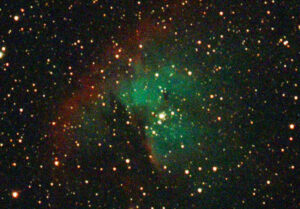
I had planned on observing open clusters in Cassiopeia with my 8″ Celestron Starsense Explorer Dob, but found them visually unimpressive under the conditions. I eventually abandoned the plan and just viewed some of my favorite objects, including the Double Cluster, M41 and the Tau Canis Majoris Cluster (Caldwell 64). I also enjoyed some multiple stars: iota Cas, beta Mon (both close triples) and HJ 3945 (winter Albireo). I was able to split gamma Ceti with 170X after a couple of unsuccessful attempts last year. Its separation is currently 1.8 arcseconds and it’ll be decreasing for the rest of my lifetime (down to less than an arcsecond twenty years from now), so I was glad to be able to split it now. I tried out a new Optolong L-Synergy SII/OIII filter with my Vespera EAA scope. I imaged the Pac-Man Nebula (NGC 281), which I had read was a significant source of SII (ionized sulfur) emissions, but it didn’t seem like much in the JPG produced by the telescope after 87 minutes of exposure time(attached image, red is SII and blue-green is doubly-ionized oxygen (OIII)). Unfortunately, I fumbled the filter trying to insert it into the filter cell in my dew shield and got fingerprints all over it as I managed to catch it before it hit the ground. I also tried out a new heated vest, and it helped to keep me comfortably warm all night. The 15 oz. of coffee that I brought in my insulated Yeti mug also helped in that regard.
Shrikant and I were the last ones left at the end of the night. I locked up HALO and the two of us locked the park gates and left at 11:25 PM.
Ernie