Impromptu Star Party (Alpha Ridge) 6/24/2026
Six HAL members attended last night’s moonlight impromptu star party at Alpha Ridge Park. The weather was fine, seeing and transparency were about average and the skies were clear except for a thin haze of high clouds.
Federico and a companion were imaging with an equatorially-mounted Seestar S30, but they left before I made my rounds to see how people were doing, so I don’t know how that went.
Alex had some software issues with his Seestar S50 and couldn’t accomplish any imaging, but he was able to view the Ring Nebula (M57) and Venus with his 10″ Dobsonian.
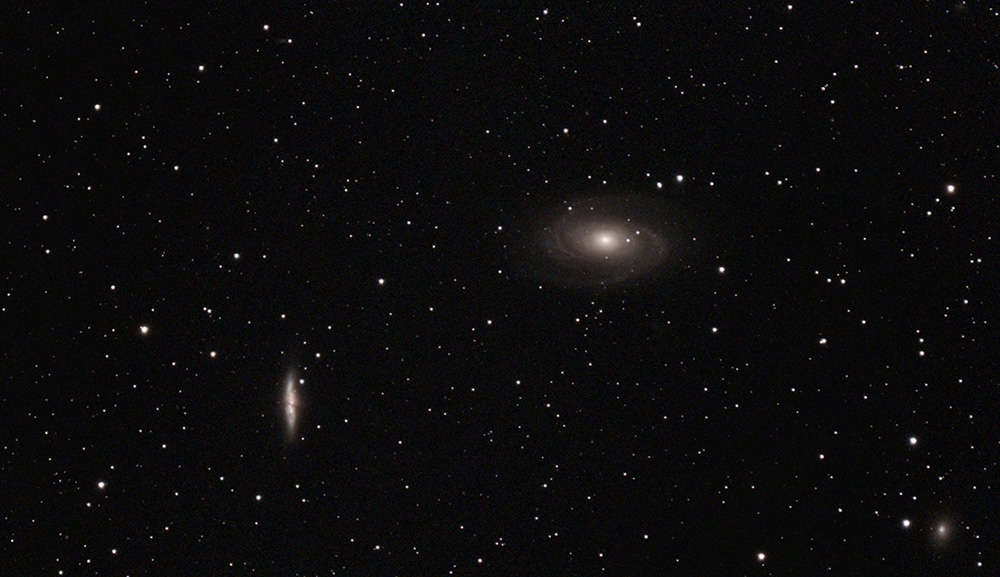
Welcome to new HAL members Forrest and Liam (father & son) who attended their first impromptu! They were working with a Celestron NexStar 8 SE. They got it aligned and under computer control and observed Bode’s Galaxy (M81) and the Whirlpool Galaxy (M51). They also tried some imaging with a planetary camera, but that was a somewhat frustrating experience.
I observed 6 double stars in Ursa Major, Coma Berenices and Lupus with my 80mm Orion Eon refractor, followed by the open clusters IC 4756 in Serpens Cauda and NGC 6633 in Ophiuchus and the Coathanger asterism in Vulpecula. I imaged the Eastern Veil Nebula through a dual-band SII/OIII filter with my Vaonis Vespera II EAA scope.
I locked all doors, verified that everything was nominal in HALO, locked the park gate and departed at 1:20 AM.
Ernie Morse
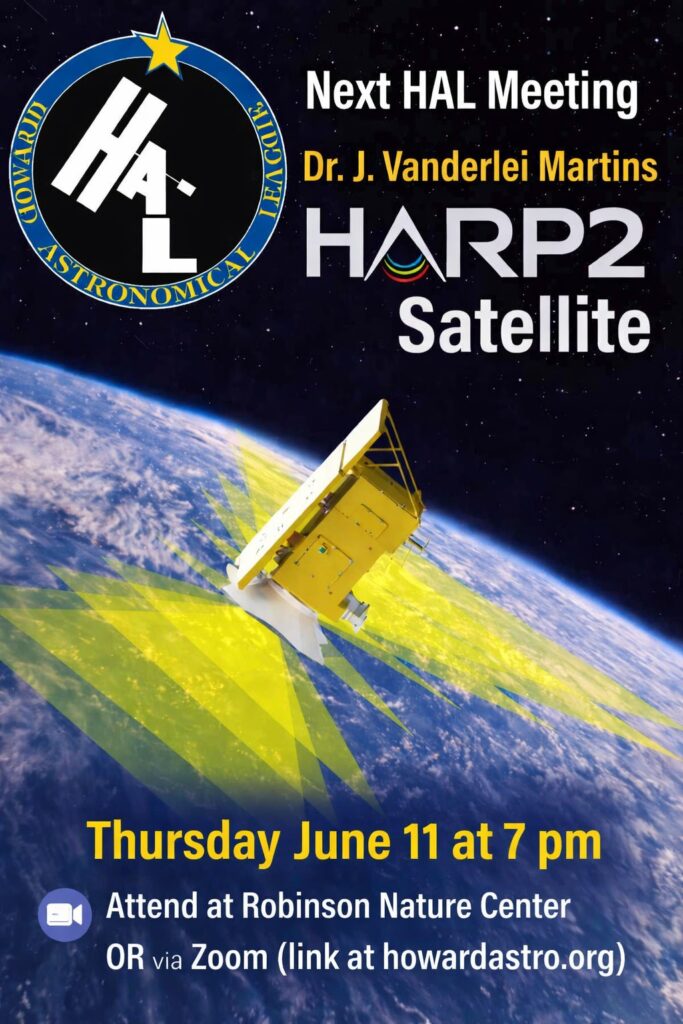
Past Monthly Meeting: June 11, 2026 – Advancing Earth Observation: The HARP2 Sensor on NASA’s PACE Satellite

Presenter: Dr. Vanderlei Martins, Director, UMBC Earth and Space Institute
Artifacts: YouTube Video Meeting PDF
The meeting took place on June 11, 2026 at 7 PM on Zoom and at the Robinson Nature Center.
Speaker:Dr. Vanderlei Martins, UMBC Earth and Space Institute
Speaker Bio:
Dr. Martins is the founder and current Director of the Earth and Space Institute at UMBC and a leading expert in aerosol and cloud remote sensing. He spent over a decade working at the Climate and Radiation Branch of the NASA Goddard Space Flight Center as part of the UMBC-GSFC Joint Center for Earth Systems and Technology (JCET), and has held faculty positions at the Department of Atmospheric Sciences of the University of Washington, and at the Department of Applied Physics of the University of Sao Paulo. For over two decades, Dr. Martins has worked closely with NASA engineers and scientists to develop advanced instruments for measuring aerosol and cloud microphysics from the laboratory to aircraft and space. He has contributed to major NASA science teams, including MODIS, Glory, and PACE satellite sensors, and serves as Principal Investigator for several cutting‑edge sensors, including the HARP and (the currently on Earth’s orbit) HARP2 spaceborne polarimeters, as well as airborne and laboratory systems such as AirHARP, PI‑Neph, Open‑INeph, PACS, RPI, and the Cloud Scanner instruments.
HAL June Monthly Meeting
Our June meeting, open to both HAL members and the public, offers a fascinating opportunity to explore the cutting edge of Earth-observing science.
This month’s speaker, Dr. Vanderlei Martins of the UMBC Earth and Space Institute, will present:
“Advancing Earth Observation: The HARP2 Sensor on NASA’s PACE Satellite”
HARP2 is the first U.S. hyper-angular imaging polarimeter ever flown in space. The instrument provides global observations every two days and captures up to 60 viewing angles across multiple wavelengths and polarization states.
These unique measurements allow scientists to study aerosols, clouds, and surface features in unprecedented detail. By examining the microphysical properties of atmospheric particles, ice and water clouds, and Earth’s surface, researchers can better understand the processes that influence weather, air quality, and climate.
Dr. Martins will highlight key discoveries from HARP2’s first two years in orbit, including observations of wildfire smoke, dust transport across continents, urban pollution, and aerosol-cloud interactions—phenomena that play critical roles in shaping our environment.
In addition to the featured presentation, we will enjoy our popular Book of the Month and Shallow Skies segments.
As always, I look forward to seeing the photographs, sketches, and artwork created by our talented members.
We hope you will join us for an evening of astronomy, Earth science, and shared discovery.
Impromptu Star Party (Alpha Ridge) 5/18/2026
Seven HAL members enjoyed a mix of visual observing and astrophotography on an unseasonably warm night at Alpha Ridge Park. There was quite a diverse collection of telescopes in use. Seeing was about average, but transparency seemed poor. Unfortunately, I started packing up before I thought to take an SQM-L reading and didn’t realize it until after I had already turned the park lights back on. My personal naked-eye limiting magnitude was worse than 4th magnitude, as I was unable to see Iota Virginis (mag 4.1). However, that was at an altitude of around 45 degrees in the southern sky, which is heavily light polluted at Alpha Ridge. Temperature was in the mid 80s to high 70s with very little wind. Dew didn’t start accumulating until after 11:00. Mosquitos were present but stealthy. I didn’t realize that I was incurring bites on the backs of my hands until they started itching, and then I applied some DEET. Better late than never!
The big news is that Sundar’s Starsense Explorer app is now working! He reinstalled it and got a new code from Celestron support, and that resolved the issues it was having. He was thrilled that it’s finally performing well and he enjoyed observing globular clusters M3, M5 and M92 and the fine double star Algieba with his 130mm Newtonian.
Jose continued imaging M101 (Pinwheel Galaxy) with his Carbonstar 150mm reflector and got a lot of good data on it.
Ian was imaging Markarian’s Chain of galaxies in the Virgo Cluster with a Seestar S50. He also noticed that the transparency wasn’t great, but he was still happy with the results.
Mike was working with a new ZWO 130mm refractor and had a lot of fun imaging M101. He said that he’s enjoying using this telescope much more than his two previous ones.
Todd started out imaging the galaxy M94 with a Celestron 9.25″ EdgeHD SCT, but switched over to M101. He showed me stacked images on his tablet at the end of the night and they looked fantastic. It was a good night for imaging the Pinwheel!
Rich was making visual observations with a TeleVue 60mm refractor and an 8″ Mag One Portaball truss tube Newtonian, which is an interesting and unique scope that I had never seen or heard of before. He was pleased to have located the globular cluster M13 with just a finder scope and also viewed the moon and double stars Castor and Mizar.
I observed 4 double stars in the northwestern sky (STF 1083, 41 Aurigae, beta Cam and 11,12 Cam) with my Orion Eon 80mm refractor and also the asterism Grohusko-1 in Virgo. I was trying out a new Svbony dew heater strap on the Orion, and it seemed to work fine (although dew was not much of an issue). I set up my 8″ Celestron Starsense Explorer Dob later in the evening and viewed M5. I tried to image M97 (Owl Nebula) with my Vespera and an OIII/SII filter, but it wasn’t able to track the target with the filter in place. I switched to imaging globulars M53 and NGC 5053, which are only 1 degree apart in the sky and are apparently close together in physical space as well. I started packing up at midnight with hopes of leaving by 12:30, but I underestimated how long it would take to break down and stow 3 telescopes! I probably won’t try to use all 3 at once again, but I had something that I wanted to try out on eac
h of them (it was a Starsense Explorer app update for the Dob). I wonder how many telescopes I could actually fit into my Elantra? There is really only one way to find out.
After packing up my totally awesome array of telescopes, I locked up HALO, verified all other doors were locked, left the park and locked the gate behind me at 12:50 AM.
Ernie Morse
Impromptu Star Party (Alpha Ridge) 5/09/2026
It was a great night for observing at Alpha Ridge Park on Saturday night. Skies were clear and transparency was above average (SQM-L reading of 19.25 mpas). Seeing was about average. The temperature was down to the mid 50s by midnight with no wind to speak of. There was some moderate dew accumulation, but it didn’t seem to be much of an issue.
Mike & Dan were both imaging the Pinwheel Galaxy (M101) with 80mm and 122mm Svbony refractors.
Welcome to new HAL member Roger, who was making visual observations with a 125mm Borg refractor.
Joey was working on troubleshooting an imaging setup with an 80mm Explore Scientific refractor. He got it working and imaged M101 for 30 minutes.
Welcome to Evan, who was also attending his first impromptu. He observed the Leo Triplet and some globular clusters with an 8″ Dobsonian while also imaging the galaxy M82 with a Seestar.
Brandon and his son were making some visual observations with a 72mm refractor.
There were a few non-members who didn’t know about the impomptu but had intended to stay at the park after dark. One family just wanted to stargaze without equipment while a couple wanted to set up a telescope for the first time. I let them know that it was a members-only event and that the park would typically be closed at dusk and gave them information about joining HAL. The family stayed until just a little after 9:00. The couple’s telescope turned out to be nonfunctional, so they also left early. Thanks to Brandon and the other HAL member(s) who gave them some guidance and advice.
It was a frustrating observational night for me. I had intended to view some brighter galaxies with my 8″ Dob, but only M81 and M82 were really worth the effort, despite the good transparency. I attempted to find the asterism Grohusko-1 in Virgo mentioned in the June issue of Sky & Telescope, but couldn’t locate it with my 8×50 finder. I made a finder chart for it with Cartes du Ciel today and I’ll use that next time. I also found the brightest star in the asterism in the Celestron Starsense Explorer app database, so I could just resort to technology and find it with the app, but I like to go old school from time to time. I did get a nice image of the asterism with my Vespera II, but that scope then disappointed me by failing to track the Owl Nebula (M97) with a 3rd-party OIII/SII filter. I salvaged the evening with some nice views of globular cluster M53 and a handful of double stars.
I verified that all park doors were locked, turned on the lights, locked up HALO, locked the gates and departed at 12:15 AM.
Ernie Morse
Impromptu Star Party (Alpha Ridge) 5/04/2026
Two HAL members attended an impromptu star party at Alpha Ridge Park on the night of May 4th. The sky clouded over intermittently, but the clouds were moving through quickly and the sky was reasonably clear most of the evening. Temperature was very pleasant (low 60s) and it was only moderately breezy. Seeing was poor, but transparency seemed at least average. I didn’t get a sky quality reading, as it was cloudy when I was done observing.
Sundar brought his Celestron 130mm Starsense Explorer Newtonian and we worked together on troubleshooting issues with the push-to app on his phone. We weren’t very successful, but I remembered that logging can be enabled and the logs can then be sent to Celestron support, so Sundar is going to try that next time.
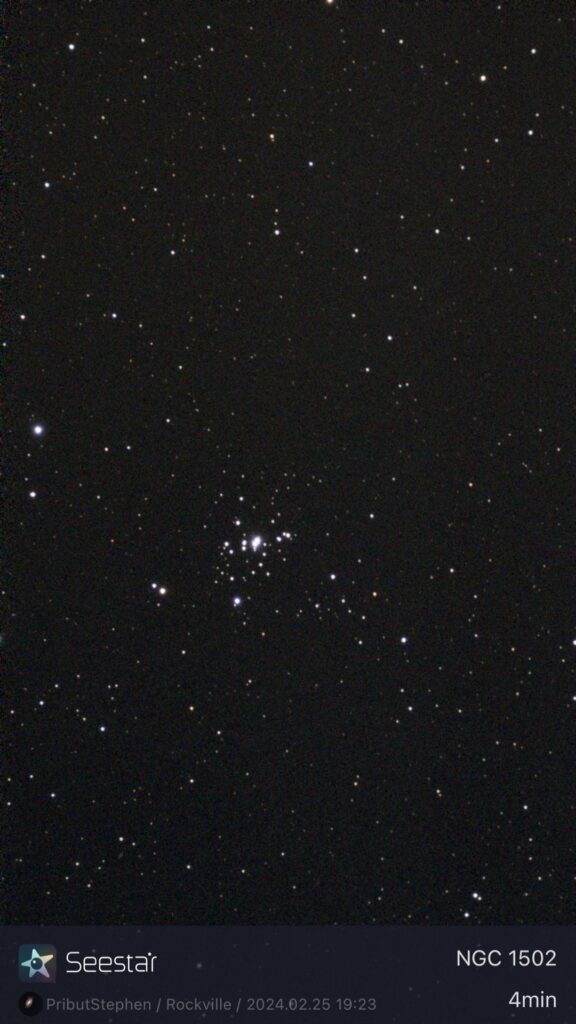
I made visual observations with my 80mm Orion refractor and 8″ Celestron Starsense Explorer Dobsonian. I observed the Kemble’s Cascade asterism in the 3-degree field of the Orion and switched to the Dob for the open cluster NGC 1502 (Golden Harp Cluster) that the cascade appears to flow into. I observed M97, the Owl Nebula, with the Dob and an OIII filter for a good while and almost convinced myself that I could see the eyes from time to time. A barred owl with a good sense of timing started hooting during those observations. I tried to see the globular cluster M68 as it was transiting in the southern sky, but I couldn’t make out any trace of it in the sky glow. I observed double stars Algieba and epsilon Lyrae with the Orion. I checked in on Jupiter with the Dob around 10:30 and noticed that one of the moons was very close to the planet’s limb. I made a note to check again later to see if it was moving towards or away from it, but didn’t get back to it until an hour later. The moon was behind Jupiter by that point. I checked Sky & Telescope when I got home and found that it was Ganymede and that it moved behind the planet at 11:06 PM.
I finished observing around 11:45 and began packing up the telescopes. I turned on the park lights around midnight, verified that all doors on the restroom building were locked, locked up HALO and departed at 12:20 AM, locking the park gate behind me.
Ernie Morse
Our Meetings
HAL General Meetings (Open to the Public) are held from 7:00PM to approximately 9:00 on the 3rd Thursday of every month via Zoom (until further notice).
HAL Planning Meetings (Open to all Members) to discuss future club direction, events, meeting topics, outreach, etc. are open to all members. They are usually held from 7:00 to 8:00PM on the 1st Monday of every month via Zoom (until further notice).
Star Parties
HAL’s public star parties at Alpha Ridge Park (normally held from March through October or early November) feature a relaxed, casual atmosphere where club members, other amateur astronomers from the area, and the public are all welcome to come and enjoy the wonders of the night sky.
Astroschool
Astroschool is usually held on the 2nd Thursday of most months at the Robinson Nature Center. Start and end times vary, but are approximately 6:30 to 8:30pm.