Sunday night’s impromptu was attended by just one HAL member (me). The moon was very bright, but skies were clear until after 10:00 and there was no wind. Temperature was down to 33 degrees at 10:30.
I observed 11 double stars across Pisces, Andromeda, Aries, Triangulum, Perseus and Orion with my 8″ Celestron Starsense Explorer Dob: 56 And, 65 Psc, gamma Ari, lambda Ari, 1 Ari, STF 183, iota Tri, 15 Tri, eta Per, iota Ori, lambda Ori. I hadn’t observed 15 Tri before and was pleasantly surprised by the vivid orange-blue color contrast. It’s a wide (142 arcsecond) optical double with magnitudes 5.6 and 6.8. The only one of my double star sources that recommended it was “Observer’s Sky Atlas” 4th edition by Erich Karkoschka, which is an excellent all-around observing guide. I like that it lists the B-V color indices for double stars to give an idea of which ones will have good color contrast.
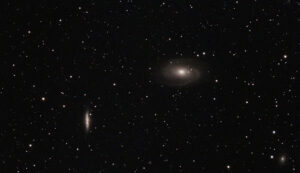
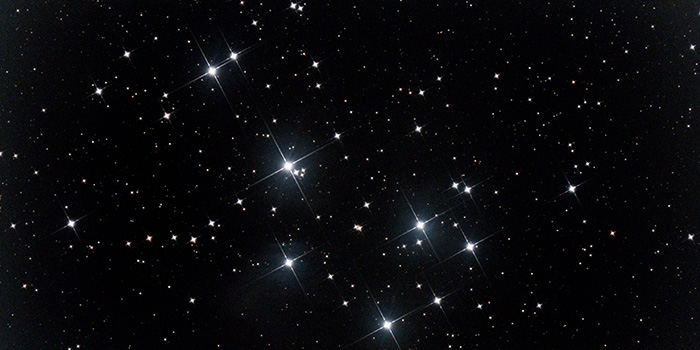
My main goal for the night was to test out the new firmware update for my Vespera II EAA scope. I took short (20 – 60 minutes) exposures of open clusters NGC 752 (Caldwell 28), NGC 2362 (Caldwell 64) and the Pleiades (M45) and galaxies M81 & M82. I also used a ring with a crossbar (purchased from Etsy) in front of the lens for the cluster exposures in order to get diffraction spikes on the stars because I like the look of spiky stars.
Clouds were moving in from the north by around 10:15 and the sky was also crisscrossed with lingering airplane contrails, so I started packing up. I locked HALO and the park gates and departed at 10:40.