

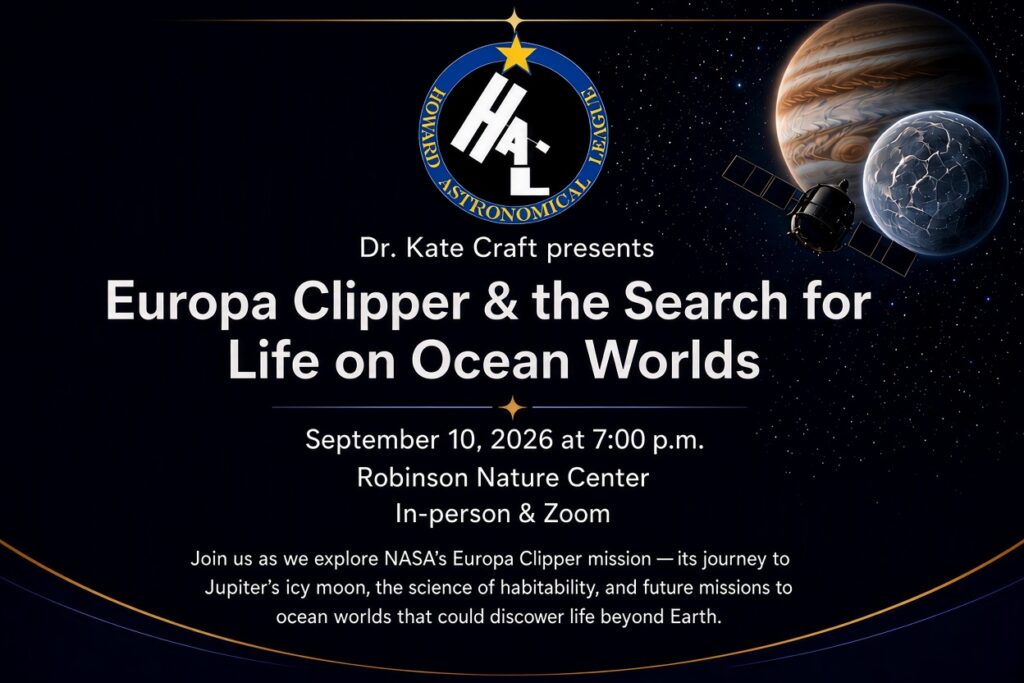
The meeting will take place on September 10, 2026 at 7 PM on Zoom and at the Robinson Nature Center.
Europa Clipper & the Search for Life on Ocean Worlds
Presented by Dr. Kate Craft
Thursday, September 10, 2026, at 7:00 p.m.
Robinson Nature Center and via Zoom
Join the Howard Astronomical League as we explore NASA’s Europa Clipper mission—its journey to Jupiter’s icy moon Europa, the science of habitability, and future missions to ocean worlds that could discover life beyond Earth.
About the Talk
Launched in October 2024, NASA’s Europa Clipper has set out on a journey to explore the habitability of Jupiter’s icy ocean world Europa. After a 5½-year cruise that includes gravity assists at Mars and Earth—the Earth flyby will occur on December 3, 2026—the spacecraft will enter orbit around Jupiter and perform nearly 50 flybys of Europa over a four-year period.
The Europa Clipper mission will assess Europa’s habitability by characterizing its ice shell and ocean, composition, and geology. The mission will also investigate cross-cutting science topics, including searching for evidence of current or recent activity: Are there plumes or cryovolcanism? Europa Clipper will also perform reconnaissance for a potential future landed mission.
Ten science instruments onboard the spacecraft will make observations and measurements, each with its own specialized designs and accommodations for operating in Europa’s harsh environment.
Future missions to ocean worlds include NASA’s Dragonfly mission, scheduled to launch to Saturn’s moon Titan in 2028. Dragonfly will analyze samples and determine how far chemistry has progressed toward life in Titan’s cold, methane- and ethane-rich environment.
Concepts for additional missions—including Europa Lander, Enceladus Orbilander, plume fly-through orbiters, and ocean-world cryobots—have also been studied. These missions would send biosignature-detection instruments to sample these environments and seek signs of life.
Although these instruments and technologies require further development to operate in the harsh and challenging environments of ocean worlds, the technology is possible—and could enable us to make the first discoveries of life outside Earth!
About Dr. Kate Craft
Dr. Kate Craft is a scientist on NASA’s Europa Clipper mission to Jupiter’s icy moon Europa. She works across the instrument and project teams to optimize the mission’s science measurements and calibrations and currently serves as co-chair of the Habitability Assessment Board.
Kate is also deeply interested in enabling the detection of life in our solar system. Toward this end, she leads the development of several sample-preparation technologies and performs fieldwork and modeling of terrestrial extreme environments.
Outside of work, Kate enjoys spending time with her husband and three children, running, and being in nature.
Read Dr. Craft’s JHU Applied Physics Laboratory profile